

INTRODUCTION
Climate change affects the basic conditions that sustain human life, from food production and access to water to health and shelter. Rising temperatures, changing rainfall patterns, sea-level rise and ecosystem degradation undermine livelihoods and communities’ prospects for a secure future. According to data released by the World Meteorological Organization (WMO), 2015-2025 period comprised the eleven warmest years on record. Yet communities exposed to the same climate hazard experience different levels of loss and impact. Income, infrastructure, access to public services, political exclusion and opportunities for protection play a decisive role in determining whether these hazards develop into a humanitarian crisis.1
Climate crisis has multiple dimensions, making it insufficient to assess international negotiations solely through emissions targets. Access to the resources needed for economic transformation, the provision of safe water in conflict zones and small-scale producers’ ability to protect their livelihoods are also directly linked to how international decisions distribute resources. In this context, climate diplomacy is a political process concerned both with cooperation against a common threat and with the distribution of costs, responsibilities, technological opportunities and decision-making authority. Success of diplomatic initiatives should therefore be assessed through the fairness of this distribution as well as the scope of the declarations adopted.
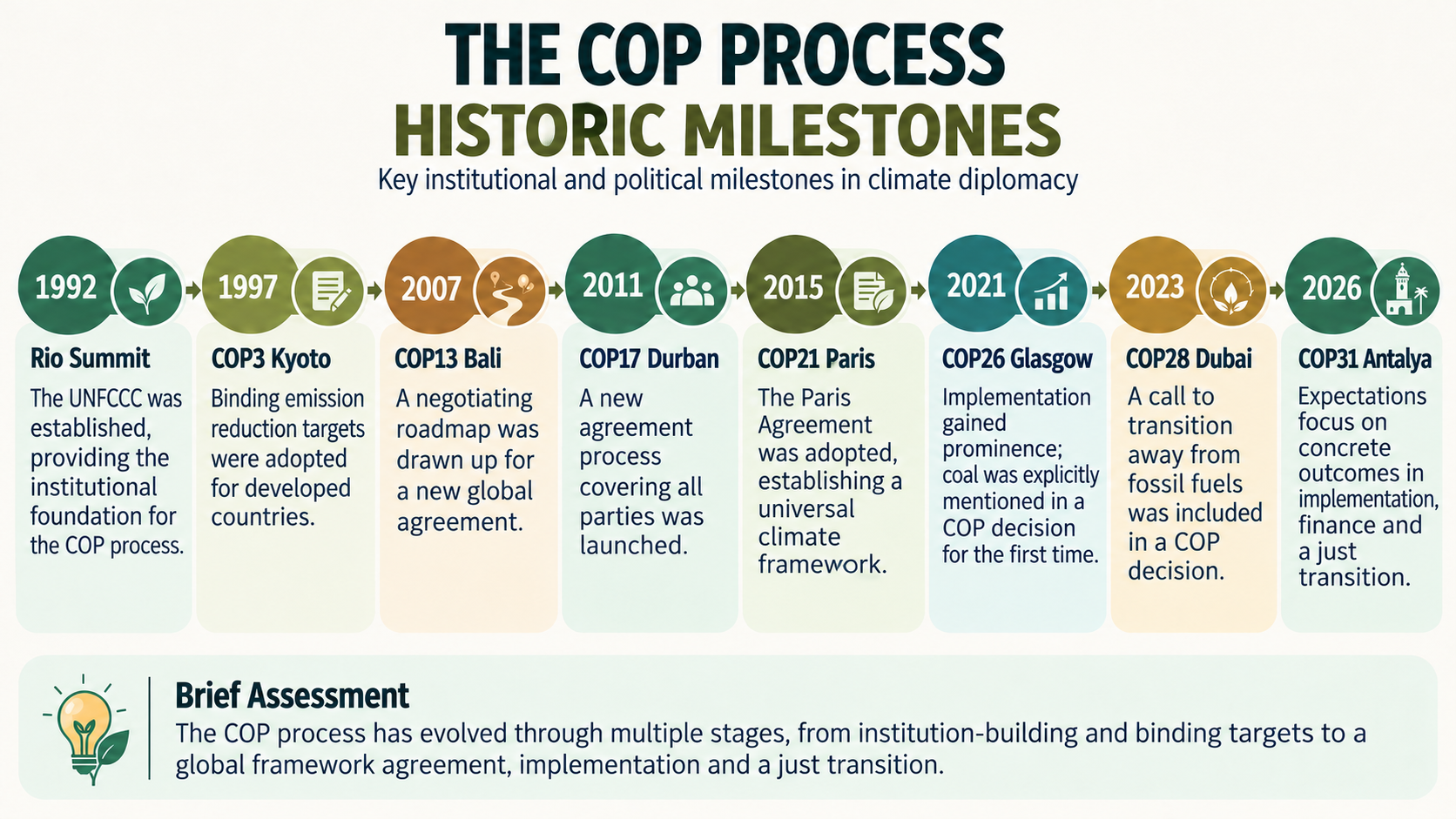
The COP process: key institutional and political milestones in climate diplomacy, from the 1992 Rio Summit to COP31 in Antalya.
In this context, COP31 in Antalya will take place at a time when the international climate regime continues to face difficulties in translating commitments into action. Hosting the conference offers Türkiye international visibility and opportunities to shape the agenda and build new partnerships. However, COP31’s lasting impact will depend on the extent to which existing commitments translate into finance, institutional capacity and social protection. Turning the opportunities offered by hosting the conference into concrete results requires consensus among the parties and sustained implementation after the conference.2
This report assesses the opportunities offered by COP31 in terms of the humanitarian outcomes and institutional functioning of climate diplomacy. Its central argument is that the distance between communities most affected by climate risk and the institutions that control resources and decision-making authority must be reduced. This requires vulnerable communities to access finance on suitable terms, participation to be supported by inclusion in decision-making mechanisms, and consistency between climate targets and economic policies to be subject to scrutiny. Humanitarian organisations’ field experience, local actors’ knowledge and academic research can make important contributions to this process. These contributions should, however, be considered within a framework that supports public institutions in fulfilling their responsibilities. A just transition that protects both human dignity and ecological integrity requires solidarity to extend beyond temporary aid relationships.
HISTORICAL DEVELOPMENT OF THE CONFERENCE OF THE PARTIES FROM BERLIN TO ANTALYA
International climate regime is founded on the United Nations Framework Convention on Climate Change (UNFCCC), adopted in 1992 and opened for signature at the Rio Earth Summit. The Convention, which entered into force in 1994, aims to stabilise atmospheric greenhouse gas concentrations at a level that prevents dangerous human interference with the climate system. While the Convention established common objectives and principles, subsequent negotiations developed the details of countries’ obligations, reporting and finance.3
The Conference of the Parties is the supreme decision-making body of the Convention and comprises the countries that are parties to it. COP, the abbreviation for ‘Conference of the Parties’, is also used to refer to the annual UN Climate Change Conference. The first meeting took place in Berlin in 1995, where the Berlin Mandate initiated a process to strengthen existing commitments. These meetings review implementation of the Convention and negotiate new arrangements. The Intergovernmental Panel on Climate Change (IPCC) is a separate body that informs the negotiations through its scientific assessments.45
One of the central disputes since the beginning of the climate regime has concerned how responsibilities should be shared among countries. The principle of Common but Differentiated Responsibilities and Respective Capabilities (CBDR-RC) calls on developed countries to take the lead while recognising developing countries’ needs and differing national circumstances. The Convention’s annexes have played a decisive role in translating differences in historical responsibility and capacity into obligations. Changes in the global distribution of economic power have, in turn, prompted debate over how these distinctions should be applied under current conditions.6
The Kyoto Protocol, adopted at COP3 in 1997 and entering into force in 2005, introduced binding quantified emissions targets for the developed-country parties covered by it. Instruments such as emissions trading, joint implementation and the Clean Development Mechanism were also developed during this period. However, the fact that not all major emitters were subject to the same obligations was one of the limitations on the Protocol’s effectiveness. The Kyoto period is significant not only for emissions reduction but also for the institutional experience it established in accounting, verification and international implementation.7
The 2007 Bali Action Plan brought mitigation, adaptation, finance, technology and capacity-building into a common negotiating framework. Despite high expectations, the 2009 Copenhagen Conference did not produce a comprehensive new treaty. The Copenhagen Accord remained a political document of which the conference merely took note. The 2010 Cancún decisions established the Green Climate Fund, while the 2011 Durban Platform launched the process of preparing a new legal instrument applicable to all parties. These developments paved the way for a transition from Kyoto’s more limited structure of obligations to a system with broader participation.8
The Paris Agreement, adopted in 2015 and entering into force in 2016, aims to hold global warming well below 2°C above pre-industrial levels and to pursue efforts to limit it to 1.5°C. At its centre are the nationally determined contributions (NDCs) that countries submit every five years. Countries set their own targets, while the submission of those targets and the monitoring of progress are governed by binding procedural obligations. This approach seeks to strengthen implementation through transparency and regular review rather than automatic penalties.9
In the negotiations, mitigation refers to reducing greenhouse gas emissions and enhancing sinks, while adaptation refers to adjustments that reduce harm arising from changing climatic conditions. Loss and damage covers impacts that cannot be prevented or fully addressed through adaptation. At the institutional level, COP is the meeting of the parties to the Convention, CMP to the Kyoto Protocol, and CMA to the Paris Agreement. The Antalya conference will host the CMP21 and CMA8 sessions alongside COP31.10
After Paris, the focus of negotiations shifted towards implementation rules. The 2018 Katowice decisions set out more detailed arrangements for communicating national contributions, transparency and assessing progress. The 2021 Glasgow Climate Pact called for the phasedown of unabated coal power and the phase-out of inefficient fossil fuel subsidies. Arrangements to operationalise the loss and damage fund, whose establishment was agreed in 2022, were adopted in 2023. The first global stocktake in Dubai also called for a just and orderly transition away from fossil fuels in energy systems.111213
The 2024 Baku Conference established a new climate finance goal, and the 2025 Belém decisions agreed to develop a just transition mechanism. The process from Berlin to Antalya has therefore substantially expanded the scope and institutional capacity of the climate regime, although gaps in finance and implementation persist. COP31’s significance will depend on the progress it enables in translating this accumulated experience into the investments and social protection that are needed.14
SCALE OF THE GLOBAL CLIMATE CRISIS
Scale of the climate crisis is tracked through ocean warming, glacier loss and sea-level rise, as well as rising temperatures. According to the WMO report, the global mean temperature in 2025 was approximately 1.43°C above the 1850-1900 average. The report also notes that ocean warming and glacier loss continued. Since annual temperature values are affected by natural variability, they should not be treated as the same indicator as the Paris Agreement’s long-term temperature goal. A cooler individual year does not mean that accumulated warming and its associated risks have disappeared.15
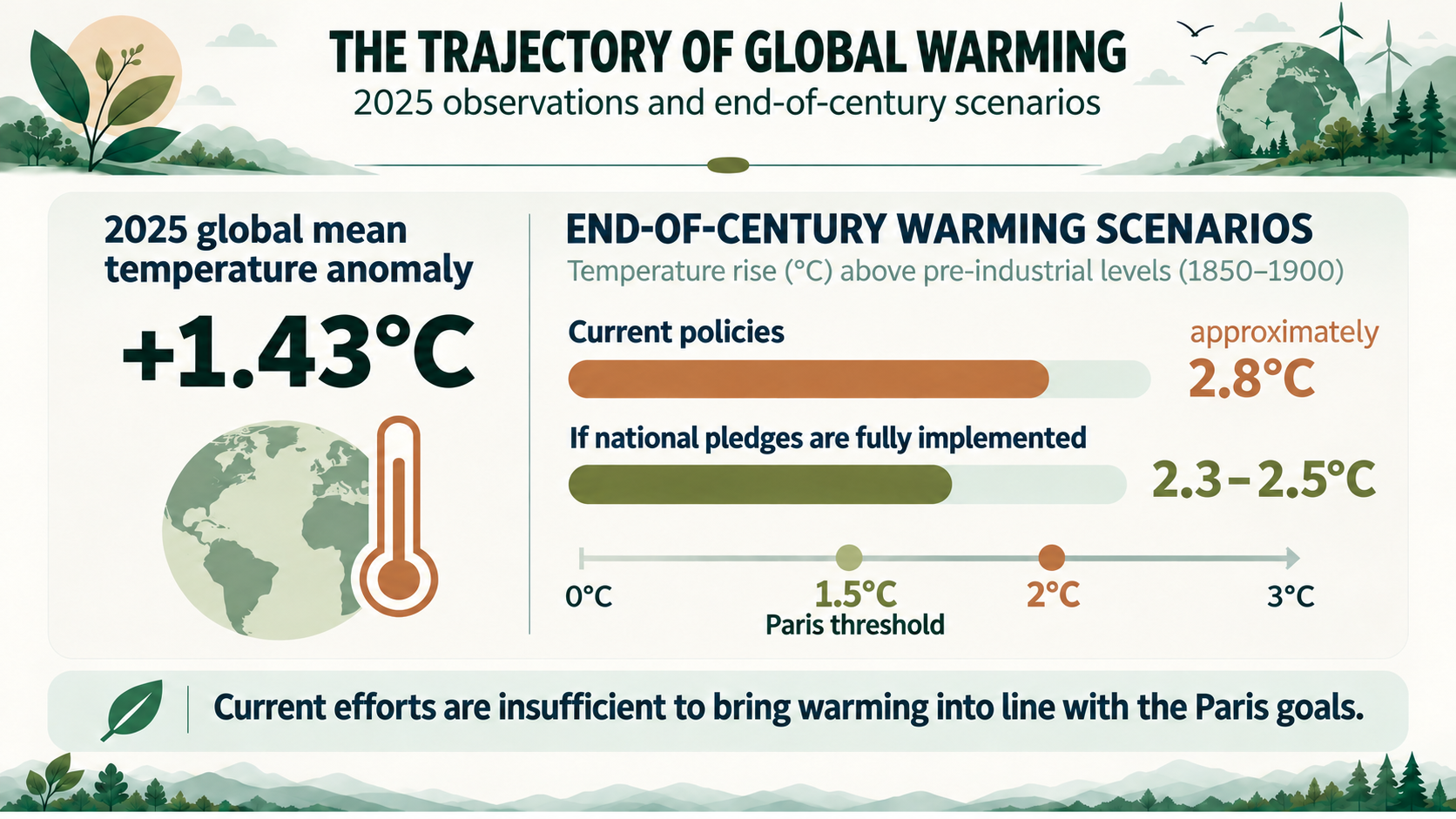
The trajectory of global warming: the 2025 global mean temperature anomaly and end-of-century scenarios under current policies and national pledges.
The IPCC report establishes that human activities, principally greenhouse gas emissions, have unequivocally caused global warming. Climate change affects the probability and intensity of certain extreme weather events, while the scale of humanitarian losses is also shaped by the conditions of the population exposed to those hazards. Approximately 3.3-3.6 billion people live in conditions that are highly vulnerable to climate change. Between 2010 and 2020, mortality from floods, droughts and storms was approximately fifteen times higher in highly vulnerable regions than in regions with very low vulnerability. This finding demonstrates the decisive influence of opportunities for protection and recovery on humanitarian losses.16
The 2022 floods in Pakistan offer an important example for assessing the economic and social impacts of disasters together. A joint assessment led by the Government of Pakistan reported physical damage exceeding US$14.9 billion and economic losses of approximately US$15.2 billion. Reconstruction and recovery needs were estimated at a minimum of US$16.3 billion. These figures distinguish damage to physical assets, losses from interrupted economic activity and reconstruction needs, revealing the scale of pressure on public finances after a disaster. In countries with limited resources, this pressure also makes it harder to maintain existing services and prepare for future disasters.17
For displaced communities, climate hazards add to losses already experienced. According to the United Nations High Commissioner for Refugees (UNHCR) assessment for 2025, approximately three-quarters of people displaced by war, violence and persecution are in countries with high or extreme exposure to climate-related hazards. The same assessment states that weather-related disasters triggered approximately 250 million internal displacement movements worldwide over the previous decade. These data include repeated movements and show how displacement can become a recurring experience. Inadequate shelter, infrastructure and social protection also make it difficult to build a secure life in places of refuge.18
Intensification of climate risks in conflict zones is directly linked to the destruction of public services and livelihoods. A water facility rendered inoperable by an armed attack can further restrict access to safe water during a drought. Research conducted by the International Committee of the Red Cross (ICRC) in Iraq, Mali and the Central African Republic also shows that conflict limits adaptive capacity. Climate adaptation must therefore be addressed alongside civilian protection and the restoration of essential services. Technical adaptation projects will have limited impact where water facilities are unprotected and local institutions cannot function.19
Extent to which current policies can reduce future risks is a separate question. The United Nations Environment Programme (UNEP) Emissions Gap Report 2025 projects warming of approximately 2.8°C over this century under current policies. Under a scenario in which national contributions are fully implemented, this falls to 2.3-2.5°C. Difference between the two scenarios demonstrates the importance of implementing commitments. Yet both outcomes remain far from the Paris goals, exposing the inadequacy of current efforts. Closing the implementation gap must therefore be accompanied by stronger targets.20
Assessing the humanitarian dimensions of the climate crisis requires examining changes in health, education and care services alongside disaster numbers and economic losses. Rising household debt, fewer opportunities to move safely and declining livelihoods can generate lasting losses. National averages do not fully capture these inequalities. Which groups receive protection, who has the means to recover and who remains excluded from decision-making should be central questions for effective climate policy.
POLITICAL ECONOMY OF ACCESS TO CLIMATE FINANCE
Impact of climate finance depends not only on the amount provided but also on the terms on which resources are used and whose priorities they serve. Who decides which activities funds will support, how risks are shared and to whom accountability is owed are therefore important questions. An activity’s necessity from a climate perspective may not be sufficient to secure support within existing financing arrangements. Essential services that do not generate direct revenue, and activities that protect vulnerable communities, can be marginalised in a financing system that prioritises commercial returns.
The New Collective Quantified Goal adopted in Baku calls for climate finance provided to developing countries, with developed countries taking the lead, to reach at least US$300 billion annually by 2035. The decision also calls on all actors to scale up total finance from public and private sources to at least US$1.3 trillion annually by the same date. The US$300 billion goal includes different sources and instruments. It consists neither entirely of public grants nor of resources additional to the broader US$1.3 trillion goal.21
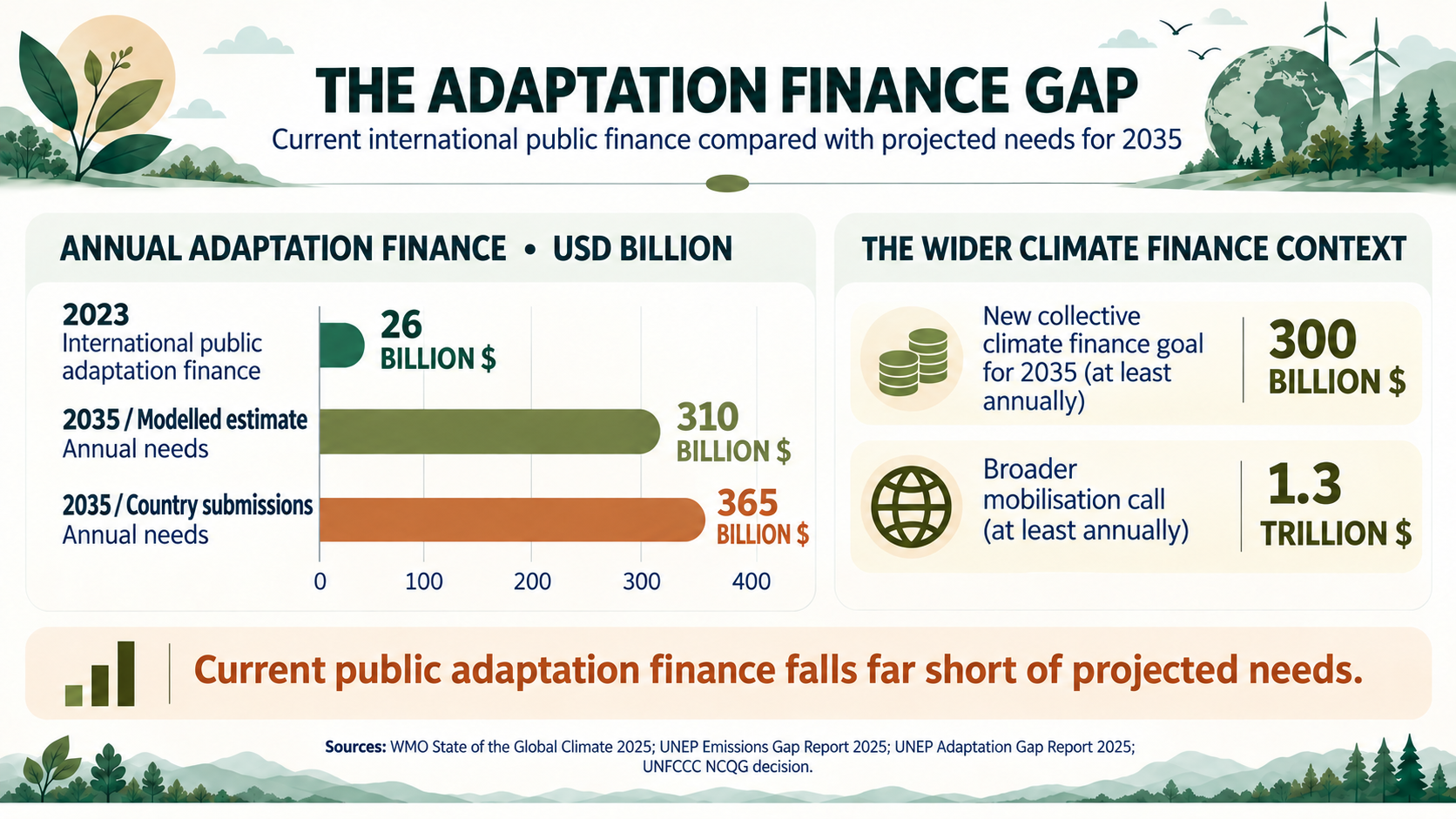
The adaptation finance gap: international public adaptation finance in 2023 set against projected annual needs for 2035.
Adaptation needs make the quality of finance as important as its volume. UNEP’s Adaptation Gap Report 2025 estimates developing countries’ annual adaptation needs in 2035 at US$310 billion using model-based calculations and US$365 billion based on needs reported by countries. By contrast, international public adaptation finance provided in 2023 amounted to only US$26 billion. The decision adopted in Belém also called for efforts to at least triple adaptation finance by 2035. Delivering on this call will depend on contributors specifying their resources and disbursement schedules.2223
Bracking and Leffel’s assessment of climate finance governance shows that a more diverse range of finance providers does not automatically distribute decision-making power, and that market-centred instruments can reinforce fund managers’ priorities. Public and humanitarian benefits should therefore also be assessed using criteria independent of financial returns.24
Access to finance becomes even more difficult in humanitarian crisis settings because needs and implementation risks are concentrated in the same places. Insecurity, data gaps, weakened institutions and disruptions to payment channels complicate project preparation and delivery. The ICRC’s findings on conflict zones likewise show that adaptive capacity must be considered alongside these institutional conditions. Requiring more documentation from local organisations in such settings may transfer responsibility to them without building the capacity they need. Leaving implementers to bear all security and financial risks increases the cost of accessing finance.25
The Green Climate Fund’s support for the Ugbaad project, implemented in Somalia through the Food and Agriculture Organization of the United Nations (FAO), demonstrates that adaptation investment is possible in fragile countries. A grant of approximately US$79.7 million was approved for the project in October 2024. However, the disbursements and results arising from this approval must be tracked. Reporting commitments, project approvals, disbursements and final expenditure separately would also show where resources are being held up and why implementation is delayed. Changes in communities’ livelihoods and protection conditions should be included in the same monitoring process.26
Arrangements to improve access to finance under COP31 should address barriers from the application stage onwards. Steps could include covering project preparation costs in advance, making documentation requirements proportionate to the size of support, and including local organisations’ overheads in project budgets. Security risks should be explicitly shared in contracts, while the record-keeping and reporting capacity needed for oversight should also receive support. This would reduce application costs and uncertainty while maintaining the accountability of funds. Strengthening access to finance requires demands for greater responsibility from local organisations to be accompanied by the means to fulfil that responsibility.
LOCAL COMMUNITIES’ REPRESENTATION AND DECISION-MAKING AUTHORITY
Local communities’ participation in climate policy is important for ensuring that decisions are fair and feasible. Yet attending meetings, expressing views and deciding how resources are used represent different levels of authority. Consulting a community that cannot change a project’s objectives or budget leaves its influence over decisions limited. Quality of participation should therefore be assessed not only by the number of representatives but also by how agendas are set, which proposals are accepted and how disagreements are resolved.
Locally led adaptation seeks to strengthen local decision-making authority in setting priorities and determining implementation. Principles published by the International Institute for Environment and Development (IIED) call for this authority to be supported by predictable finance and for structural inequalities to be addressed. Local knowledge should not remain a supplementary input used to validate an externally designed project. Giving local actors a voice in defining problems, selecting interventions and evaluating outcomes would strengthen the relationship between implementation and social needs.27
Direct access to finance is one instrument that can support this approach. The Adaptation Fund’s direct access model enables accredited national implementing entities to receive funding without an international intermediary. However, management of resources by a national institution does not automatically give communities authority over budgets. Since reduced international intermediation can coincide with the concentration of decision-making power in national centres, the relationship between direct access and local decision-making processes must be examined.28
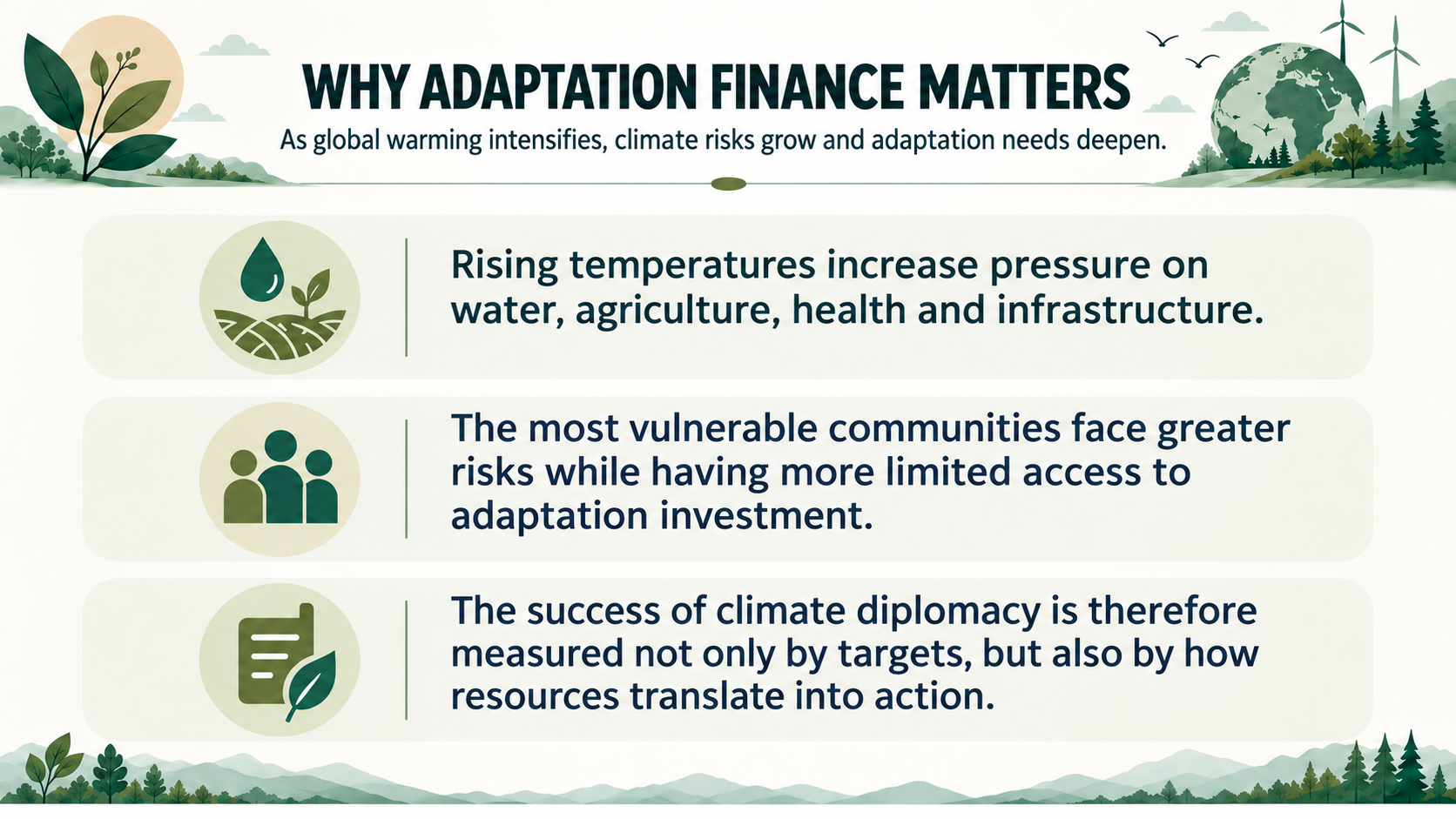
Why adaptation finance matters: rising temperatures, unequal exposure and uneven access to investment shape how climate diplomacy is judged.
The Adaptation Fund’s single-country locally led adaptation grants can provide up to US$5 million per project or programme. Applications are submitted through accredited implementing entities with endorsement from the designated national authority. The programme provides up to US$150,000 for project preparation. An additional amount of up to US$100,000 may be considered on a case-by-case basis to strengthen local actors’ involvement in design. These instruments, which allow preparation and participation costs to be covered before implementation begins, should be linked to partnerships accessible to local organisations.29
Local communities also contain differing interests and power relations. Municipal authorities, women’s organisations, small-scale producers, displaced people and landless households may not share the same priorities. Studies show that some adaptation interventions can reproduce vulnerability or transfer it to other groups rather than reduce it. Superficial definitions of problems and unequal participation in decision-making are among the causes of these outcomes. Strengthening local leadership therefore also requires attention to exclusion within communities.30
The Local Communities and Indigenous Peoples Platform under the UNFCCC provides an institutional space for knowledge exchange and the development of capacity for participation. Its Baku Workplan for 2025-2027 aims to strengthen the contribution of local and Indigenous knowledge systems to climate processes. Where it is unclear which institution will address the demands expressed through such platforms or how those demands will inform budget decisions, greater international visibility has limited practical impact.31
Under COP31, the financial conditions for participation and its influence on decisions should be addressed together. Interpretation, travel, care support and accessible meeting arrangements should be included in project budgets. Selection of representatives, their terms of office, conflict-of-interest rules and appeal mechanisms should also be made clear from the outset. Publishing the budget items changed in response to local proposals, together with reasons for rejecting other requests, would demonstrate how effective participation has been. This would allow an assessment of how authority is shared beyond general statements that communities have been included.
CONTRADICTIONS AND SELECTIVE RESPONSIBILITY IN CLIMATE POLICY
The credibility of climate policy depends on consistency between international targets and countries’ economic and environmental decisions. A country’s energy investments, production permits and public support can either reinforce its announced net-zero target or make that target harder to achieve. Resource allocation and the economic lifespan of investments should therefore be examined alongside stated targets. The criticism of hypocrisy in climate policy has a concrete basis in the continued pursuit of ambitious commitments alongside policy choices that undermine them.
The Production Gap Report 2025 shows that governments’ planned total fossil fuel production in 2030 is more than twice the level consistent with the 1.5°C goal. This finding demonstrates that targets to reduce energy consumption cannot be considered independently of decisions that expand production. New fossil fuel investments create economic expectations and political interests that can last for many years. The adequacy of targets must therefore be assessed against planned capacity as well as existing production.32
The United States’ (US) withdrawal from the climate regime poses a significant problem for the continuity of commitments. According to UN depositary records, the second US withdrawal from the Paris Agreement took effect on 27 January 2026. Notification of withdrawal from the UNFCCC was submitted on 27 February 2026, with the withdrawal due to take effect on 27 February 2027. Such policy shifts by major economies affect both the scope of collective efforts and the reliability of financing expectations. More resilient financial and institutional arrangements are needed if long-term transition programmes are to continue despite changing political preferences.3334
Delays cannot be explained solely by gaps in knowledge or technical capacity. Public budgets dependent on fossil fuel revenues, geographically concentrated employment and companies invested in existing infrastructure all influence transition decisions. Studies of the transition to a low-carbon economy also draw attention to this relationship between energy policy and economic interests. When costs are concentrated among particular groups while benefits emerge over a longer period, resistance to change can grow. The political conditions for transition must therefore be considered alongside cost-sharing and the creation of alternative livelihoods.35
Production activities to which financial resources are directed form another dimension of this relationship. Research examining the relationship between sectoral lending and emissions in Türkiye using 2014 and 2018 input-output tables highlights the need to assess the effects of finance throughout supply chains as well as through direct emissions. Assessing the relationship between environmental targets and lending and investment decisions also requires examining the indirect emissions of activities supported by instruments presented as green finance.36
Selective interpretations of responsibility also weaken trust among countries. Focusing only on current annual emissions can obscure historical accumulation, while relying only on past emissions can understate major economies’ present capacities and future impacts. National averages can also conceal differences between high-consuming groups and communities struggling to meet basic needs. Unequal vulnerabilities and participation in decision-making, emphasised in the climate justice literature, must therefore be considered alongside national comparisons. Historical contributions, current emissions, economic capacity and development needs should be assessed together. Long-term effects of short-term decisions justified on energy security grounds must also be scrutinised. Building trust at COP31 will depend on acknowledging these contradictions and setting clear timetables to address them.37
CLIMATE DIPLOMACY FOR THE GREEN TRANSITION
Green transition requires changes in production structures, infrastructure, trade relations and consumption patterns as well as energy sources. Scope of climate diplomacy therefore extends beyond negotiations among environmental institutions. Decisions by finance, trade, industry, agriculture and foreign policy institutions directly affect the pace and social consequences of the transition. Coordination across institutions is needed to ensure that objectives in these areas reinforce one another, while foreign policy initiatives should facilitate access to technology and finance on favourable terms.
According to the International Energy Agency’s (IEA) estimates for 2026, global energy investment is expected to reach US$3.4 trillion, including approximately US$2.2 trillion in clean energy investment. Investment is concentrated particularly in China, the US and the European Union (EU). This growth demonstrates the increasing economic importance of low-emission technologies. It does not, however, mean that developing countries can access the same resources at comparable costs. Enabling countries disadvantaged by high capital costs and limited institutional capacity to participate in the transition requires improved access conditions as well as higher investment volumes.38
Trade regulations are one area in which these inequalities become more visible. The definitive phase of the EU’s Carbon Border Adjustment Mechanism began on 1 January 2026. The mechanism aims to reduce carbon leakage by accounting for the embedded emissions generated in producing the imported goods it covers. Carbon leakage is the risk that production shifts to countries with less stringent climate rules or is replaced by more emissions-intensive imports. The regulation’s environmental objective should be assessed alongside its costs for exporting countries and businesses.39
Increased imports of clean technology do not, by themselves, establish lasting technical capacity in importing countries. Continuity of investments in solar panels, batteries and electric vehicles depends on maintenance and repair, grid management, vocational training and recovery and recycling capacity. Diplomatic agreements’ contributions to local production and knowledge are therefore important. For critical mineral investments, the effects of land and water use on communities must be examined from the outset. Need for low-emission technologies does not remove social and environmental responsibilities in their production.
Nature-based solutions, such as wetland conservation, watershed rehabilitation and coastal ecosystem restoration, can help reduce disaster risk and livelihood losses by addressing climate adaptation and ecosystem protection together. These approaches should not substitute for a transition away from fossil fuels or be reduced to tree planting, and they should protect local rights and biodiversity. Selecting unsuitable species or restricting communities’ use rights can cause an initiative launched for environmental purposes to generate new losses.40
Climate cooperation across different institutions also makes clarity of roles and responsibilities important. Concept of the climate regime complex considers both the flexibility offered by decentralised arrangements and the difficulties of coordination among institutions. COP31 can help connect trade, energy, development and humanitarian initiatives to shared objectives. This requires preventing the same investment from being counted repeatedly under different programmes and specifying each institution’s responsibilities and how outcomes will be monitored. A growing number of partnerships will be beneficial to the extent that they complement one another in practice.41
TÜRKİYE AND CLIMATE DIPLOMACY IN THE CONTEXT OF COP31
Türkiye’s climate diplomacy has been shaped by the relationship between its position in the international regime and its development and energy priorities. The UNFCCC’s original annex system long played a decisive role in debates over responsibilities and access to finance. Decision 26/CP.7, adopted in 2001, provided for Türkiye’s removal from Annex II and called for recognition of its special circumstances, which distinguish it from other Annex I parties. Although this arrangement changed Türkiye’s position, it did not exempt the country from all Convention obligations or provide automatic access to climate funds.42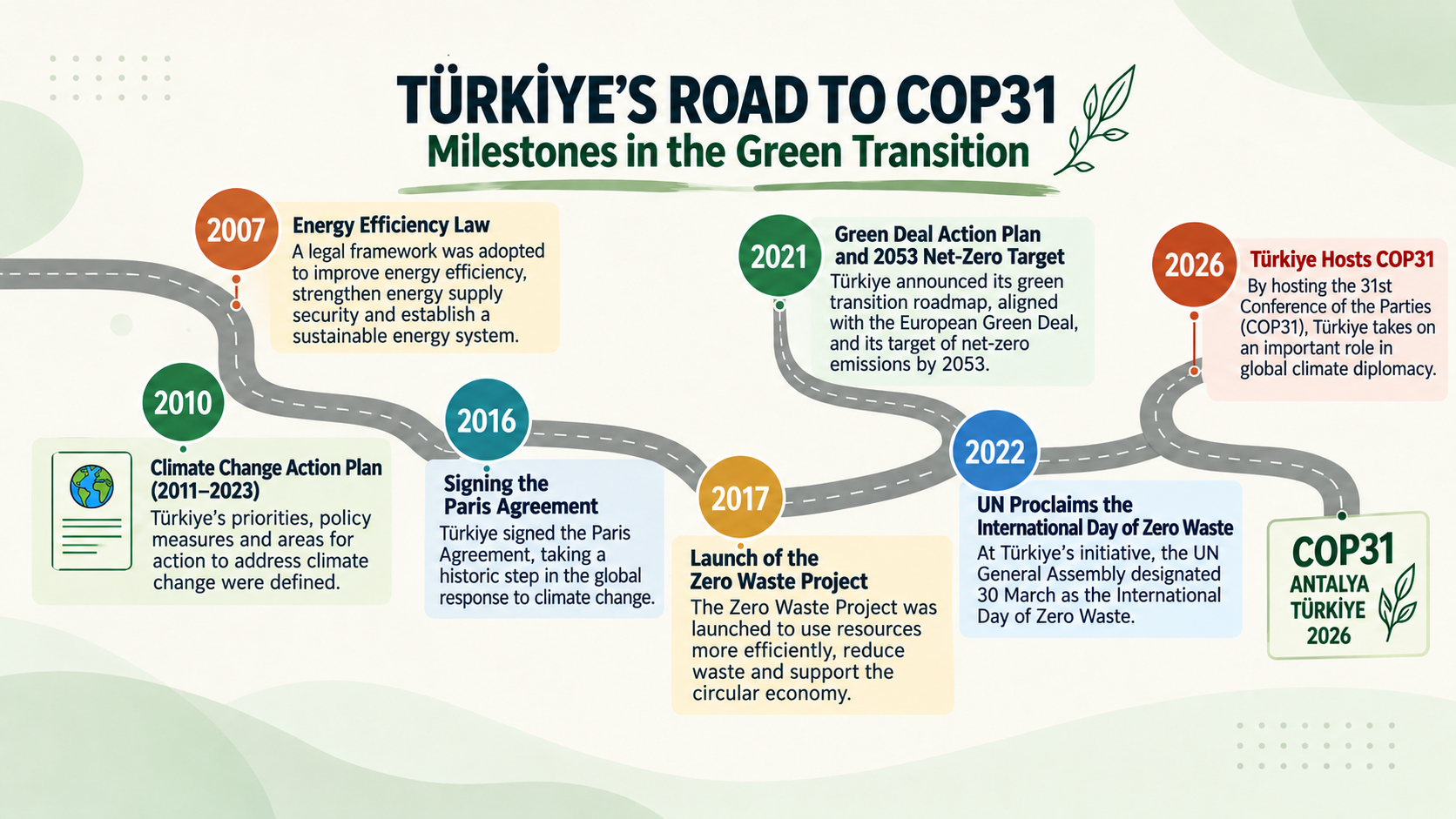
Türkiye’s road to COP31: milestones in the green transition, from the 2007 Energy Efficiency Law to hosting COP31 in Antalya.
Türkiye became a party to the UNFCCC in 2004 and the Kyoto Protocol in 2009, and ratified the Paris Agreement in 2021. Academic debate in Türkiye on the Paris Agreement has likewise examined the country’s position through the relationship between development classifications, financing expectations and national policy choices. While this historical background remains important, the current diplomatic agenda should extend beyond demands for recognition of special circumstances. Managing economic transformation and implementing national targets will directly affect Türkiye’s international credibility.43
Türkiye’s second nationally determined contribution, submitted in 2025, aims to limit greenhouse gas emissions in 2035 to 643 million tonnes of CO₂ equivalent, a reduction of 466 million tonnes against the reference scenario. The figure of 458.8 million tonnes in the document refers to net emissions in 2018, including land use and forestry.44
Climate Law No. 7552, published in the Official Gazette on 9 July 2025, provides an important legal basis for assessing national implementation. The law covers mitigation and adaptation activities, planning and implementation instruments, permitting and inspection, and provides for annual monitoring of progress by the Directorate of Climate Change. The impact of this framework will depend on the budgets available to institutions to fulfil their duties and the transparency with which implementation outcomes can be tracked. Preparations for COP31 should also be used to strengthen the relationship between international targets and national plans and investments.45
Division of responsibilities between Türkiye and Australia is important for the diplomatic approach to COP31. Türkiye will host the conference and hold the COP presidency, while Australia will serve as President of Negotiations. Requiring continuous coordination between the two countries, this arrangement could help bring the Mediterranean’s transition and adaptation needs together with the Pacific’s experience of climate vulnerability on a shared agenda. This requires attention to the priorities of different country groups and a division of presidential responsibilities that works in a way that builds confidence.46
Türkiye’s opportunity to bring different priorities together and develop partnerships for implementation is also significant. Meeting this expectation requires proposals that address access to finance alongside oversight needs, industrial transformation alongside competitiveness concerns, and climate targets alongside social protection. For Türkiye, the search for consensus should encompass how costs and responsibilities will be shared as well as bringing parties’ demands together in a common narrative.47
Areas in which COP31 could deliver lasting domestic benefits include industrial energy efficiency, electricity system transformation, water management, agricultural resilience and local climate planning. Each initiative requires a responsible institution, budget and implementation timetable. Türkiye’s experience in humanitarian diplomacy could also contribute to partnerships on water, agriculture, early warning and resilient essential services in crisis settings. Humanitarian organisations’ local relationships should be supported by technical climate assessments and environmental safeguards. A condition of these partnerships from the outset should be that affected communities can express their needs and participate in implementation decisions.
ROLE OF CIVIL SOCIETY IN CLIMATE DIPLOMACY
Civil society organisations perform different roles in climate diplomacy, including knowledge production, advocacy, implementation and oversight. Humanitarian organisations, research centres, trade unions and community-based groups work in this field alongside environmental organisations. These actors do not have the same decision-making authority as states. Their influence should therefore be assessed through their contribution to agenda-setting and the extent to which they strengthen opportunities to demand accountability. Connecting field knowledge with negotiating agendas can help reveal needs that are insufficiently visible in national indicators.
Research on post-Paris climate governance discusses the growing role of non-state actors in terms of legitimacy, justice and effectiveness. Organisations able to attend international meetings regularly and employ specialist staff do not have the same resources as small local organisations. Broader participation therefore does not automatically resolve inequalities in representation. Organisations should also explain whom they represent, how they formulate demands and how they are accountable to the groups they represent. Otherwise, well-organised actors may gain visibility while the demands of the most affected communities remain marginalised.48
Humanitarian organisations possess field knowledge that can reveal how climate risks accumulate in people’s daily lives. This could include the seasonal reliability of water sources, the continuity of health services after a disaster, or the effects of agricultural losses on household debt. To turn field experience into a comparable source of knowledge with clearly understood limitations, research must specify its location, period, population groups and methods. Communities’ own assessments should also be directly included in interpreting the findings.
Linking nature-based solutions with humanitarian programmes is one practical area in which this knowledge can be used. Mangrove restoration in Vietnam, discussed in a joint report by the International Federation of Red Cross and Red Crescent Societies (IFRC) and the World Wide Fund for Nature (WWF), illustrates the relationship between coastal ecosystem protection and the reduction of disaster risk and livelihood losses. This restoration process aims to return degraded tropical and subtropical coastal ecosystems to a functioning state. Such examples show the importance of considering ecosystem characteristics, continued maintenance and communities’ land-use rights together in project design.49
Success of similar initiatives should not, however, be measured solely by the area restored or the number of seedlings planted. Ecological suitability, survival rates, water requirements and effects on local livelihoods must also be monitored. Activities begun without clear maintenance responsibilities and regular funding are difficult to sustain. In areas with urgent shelter or safe water needs, long-term restoration should be planned alongside immediate protection measures. Humanitarian organisations need to address needs across both timeframes within the same programme.
Organisations’ own environmental impacts should also be subject to scrutiny. The 2021 Climate and Environment Charter for Humanitarian Organizations addresses responses to climate risks, reduced environmental impacts, local leadership and accountability together. Measurable targets should be set for changes in procurement, logistics, energy use and waste management, and results should be reported regularly. These arrangements must also preserve the capacity to provide timely assistance in accordance with humanitarian principles.50
Civil society organizations can develop joint work that brings field knowledge into negotiations. Documenting barriers to finance in crisis settings and independently evaluating practice are important areas for such work. Local organisations should participate in defining research questions, interpreting findings and deciding how they are published. Value of this cooperation lies less in the number of texts produced on communities’ behalf than in how far it expands their ability to express their own demands and influence decisions.
EXPECTATIONS FOR COP31 AND A JUST TRANSITION
Expectations for COP31 should be defined through steps that bring existing decisions on finance, adaptation, technology and a just transition closer to implementation. Formal negotiating decisions, voluntary presidency initiatives and bilateral agreements announced during the conference operate under different mandates and financing conditions.
Provisional agenda published in September 2026 provides a preparatory framework for the issues expected to be considered at the conference. The electrification, zero-waste and resilient cities targets announced by the COP31 Presidency in June 2026 form part of its action agenda. Bringing different actors together in these areas could expand implementation opportunities. However, participants must specify the resources they will provide, their responsibilities and their timetables. The relationship between the action agenda and the negotiating process should also be established through these concrete contributions.5152
A just transition addresses the consequences of the shift to a low-carbon economy for workers and communities. The International Labour Organization’s (ILO) approach links the transition with decent work, social protection and social dialogue among governments, workers and employers. Workers who lose their jobs cannot be expected to find new employment entirely through their own means. Since continued public support is closely related to how costs are shared, resources for vocational training, income security and regional development must be allocated from the start of the transition.53
Decision 2/CMA.7, adopted in Belém, agreed to develop a just transition mechanism to support international cooperation, technical assistance, capacity-building and knowledge-sharing. Process for operationalising it is expected to be considered at CMA8. Informal note prepared for the June 2026 negotiations states that its content has not yet been agreed and that the document has no formal status. Priority in Antalya should therefore be to clarify the mechanism’s functions and its relationship with existing institutions. Presenting it as a new fund with finalised rules and secured financing would misrepresent its current stage of development.5455
Scope of a just transition should not be limited to formal workers in fossil fuel sectors. It should also include low-income households affected by energy prices, small-scale producers, informal workers and communities whose land-use opportunities change because of investments. Quality, wages and accessibility of new jobs for different groups matter as much as their creation. Delaying social support until after the transition is complete can deepen economic losses and increase political resistance. Social protection should therefore be part of investment decisions from the outset.
Implementation requires identifying which tasks existing institutions can perform and where new capacity is needed. Creating new structures without resources or staff may further obscure responsibility. The presidency can facilitate the division of responsibilities and the setting of implementation timetables among countries and financial institutions. Key outcomes to monitor should include access to project preparation support in crisis settings, local actors’ role in budget decisions, the terms of adaptation grants and the resources allocated to just transition plans. Passing the monitoring arrangements established in Antalya on to subsequent presidencies would also support continuity in implementation.
COP33 AND THE OUTLOOK FOR 2028
COP33’s significance is directly linked to the Paris Agreement’s timetable for assessing progress. Under Article 14, the first global stocktake took place in 2023, with subsequent stocktakes scheduled every five years. On this timetable, 2028 will be an important year for reassessing collective progress. Results delivered by then through the instruments and partnerships developed at COP31 would provide a basis for assessing the Antalya conference’s lasting contribution.56
There have been reports that COP33, scheduled for 2028, may be hosted by China. However, in the absence of a definitive and verified announcement, the implications of China potentially hosting the conference should be considered conditionally. Regardless of the host country, the second global stocktake will reopen debate on major economies’ targets and implementation.57
China’s economic weight in the energy transition is an important element of this debate. According to IEA data, its clean energy investment exceeded US$625 billion in 2024. The agency’s 2025 report estimated that investment in coal supply would exceed US$54 billion that year. The continued investment in both clean energy and coal shows that growth in new technologies is not proceeding at the same pace as the transition away from fossil fuel infrastructure. China’s performance should be assessed through the trajectory of total emissions as well as newly installed capacity.58
China’s 2035 nationally determined contribution aims to reduce economy-wide net greenhouse gas emissions by 7-10% from their peak level and to strive for further reductions. It also sets a target to increase the share of non-fossil sources in total energy consumption to more than 30%. Adequacy of the emissions target will depend on the year and level at which emissions peak and the subsequent rate of decline. Alongside China’s strong position in clean technology manufacturing, the extent to which its targets meet global mitigation needs should also be examined.59
Expanded cooperation in the period to 2028 could facilitate access to clean technologies and investment in developing countries. If China is confirmed as host, it could strengthen the implementation agenda through affordable technologies and joint projects. Quality of these partnerships should be examined in terms of debt burdens, technology-sharing and contributions to local economies. Conversely, deeper trade and security competition could lead to diverging standards and more limited supply options. Pressure to choose between economic blocs would make it harder for developing countries to pursue their own development priorities.
Another risk is that resources fail to reach the places where they are needed despite a growing number of technology and investment announcements. Regardless of the host country, this could allow conferences to push implementation gaps into the background. Emissions data, financial records and affected communities’ assessments should therefore form the basis for reviewing progress. Even when diplomatic relations become difficult, cooperation should be maintained in areas of shared benefit, such as early warning, adaptation research and access to essential technologies. Türkiye’s priority in this context should be to turn COP31 partnerships into programmes with reportable results in 2027-2028.
CONCLUSION AND RECOMMENDATIONS
Main problem of climate diplomacy is that recognition of a common threat has not produced sufficient progress towards a fair distribution of costs and responsibilities. Targets, reporting arrangements and financial institutions developed since Berlin represent a substantial body of experience. Yet communities facing the greatest concentration of risk may still have limited access to resources and decisions. COP31’s contribution will emerge through arrangements that strengthen this access. The humanitarian value of diplomatic success should be assessed through the extent to which people’s security, livelihoods and position in decisions about their own futures improve.
First, fund managers and finance providers should develop access arrangements suited to conditions in crisis settings. Support that covers project preparation costs in advance should be established with accredited entities, designated national institutions and local partners. Application requirements should be proportionate to the size of funding, and oversight and security responsibilities should be shared. A pilot launched after COP31 could track preparation time, the time taken to obtain approval and local organisations’ uncovered costs over one year.
Second, funds and implementing organisations should report grants and loans, approvals and disbursements, and disbursements and final expenditure separately. Adaptation activities supporting essential services in crisis settings should prioritise grants and instruments that do not create debt. Expenditure recorded as climate finance should be defined through clear criteria, and the same resources should not be counted more than once. At the same time, evaluation should focus on the protection of beneficiaries and the continuity of services.
Third, local participation should be supported by authority over budget and implementation decisions. The selection of community representatives and the decisions in which they will participate should be specified from the outset. The participation costs of women, persons with disabilities, displaced people and groups without property ownership should be covered. Independent appeal mechanisms should be available when local authorities and communities disagree.
Fourth, governments should explain how new energy and industrial investments relate to national contributions and how public support affects emissions and social conditions. Joint reviews by the relevant institutions should be open to parliamentary oversight, and data should be accessible for independent research. Where inconsistencies with targets are identified, a timetable for corrective action should be published. Changes that may cause job losses or reduce regional incomes should be planned alongside resources for social protection and alternative economic activities.
Fifth, Türkiye should develop practical partnerships on water and agricultural resilience, access to finance and local decision-making. The responsibilities of relevant ministries, municipalities, universities and humanitarian organisations should be specified, and local partners should have authority in research and implementation processes. Programme baselines, budgets and targets for 2027–2028 should be disclosed. Sharing results before COP33 would enable the impact of hosting the conference to be assessed through concrete implementation.
Sixth, nature-based solutions and just transition programmes should be implemented with social and ecological safeguards. Land and water-use rights, maintenance responsibilities and long-term costs should be established from the outset. Humanitarian organisations should plan for immediate needs and long-term resilience together, while research centres should evaluate outcomes independently. Monitoring should cover the continued functioning of ecosystems, income security, access to services and excluded groups’ position in decision-making.
Implementing these recommendations requires solidarity to be supported by clear responsibilities, resources and accountability relationships. Unless arrangements that restrict access to finance and local actors’ decision-making authority change, the humanitarian value of targets announced at conferences will remain limited. In the period leading to COP33, the success of diplomatic initiatives should be measured by reduced humanitarian losses and the strengthened capacity of public institutions to protect people. Ability of those most exposed to climate risks to have a say in their own futures is a fundamental condition for a just transition.
ENDNOTES
1. World Meteorological Organization (WMO). 2026. “State of the Global Climate 2025.” 23 March 2026. Available at: https://wmo.int/publication-series/state-of-global-climate/state-of-global-climate-2025
2. UNFCCC. 2026. “UN Climate Change Conference - Antalya, November 2026.” Available at: https://unfccc.int/cop31
3. United Nations. 1992. “United Nations Framework Convention on Climate Change.” Articles 2–3 and 7.
4. UNFCCC. 1995. “The Berlin Mandate: Review of the Adequacy of Article 4, Paragraph 2(a) and (b), of the Convention, Including Proposals Related to a Protocol and Decisions on Follow-up.” Decision 1/CP.1. FCCC/CP/1995/7/Add.1, 6 June 1995, pp. 4–6.
5. UNFCCC. “Conference of the Parties (COP).” Available at: https://unfccc.int/process/bodies/supreme-bodies/conference-of-the-parties-cop
6. United Nations. 1992. “United Nations Framework Convention on Climate Change.” Articles 2–3 and 7.
7. UNFCCC. 1997. “Kyoto Protocol to the United Nations Framework Convention on Climate Change.” Articles 3, 6, 12 and 17.
8. UNFCCC. 2007. “Bali Action Plan.” Decision 1/CP.13. FCCC/CP/2007/6/Add.1.; UNFCCC. 2009. “Copenhagen Accord.” Decision 2/CP.15. FCCC/CP/2009/11/Add.1.; UNFCCC. 2010. “The Cancun Agreements.” Decision 1/CP.16. FCCC/CP/2010/7/Add.1, paragraph 102.; UNFCCC. 2011. “Establishment of an Ad Hoc Working Group on the Durban Platform for Enhanced Action.” Decision 1/CP.17. FCCC/CP/2011/9/Add.1, pp. 2–3.
9. UNFCCC. 2015. “Paris Agreement.” Articles 2, 4, 7–8 and 14–16.
10. UNFCCC. 2026. “UN Climate Change Conference - Antalya, November 2026.” Available at: https://unfccc.int/cop31
11. UNFCCC. 2018. “Matters Relating to the Implementation of the Paris Agreement.” Decision 3/CMA.1. FCCC/PA/CMA/2018/3/Add.1, 19 March 2019, pp. 3–4, paragraph 4.
12. UNFCCC. 2021. “Glasgow Climate Pact.” Decision 1/CMA.3. FCCC/PA/CMA/2021/10/Add.1, paragraph 36.
13. UNFCCC. 2023. “Operationalization of the New Funding Arrangements, Including a Fund, for Responding to Loss and Damage.” Decision 1/CP.28. FCCC/CP/2023/11/Add.1.; UNFCCC. 2023. “Outcome of the First Global Stocktake.” Decision 1/CMA.5. FCCC/PA/CMA/2023/16/Add.1, paragraph 28(d).
14. UNFCCC. 2024. “New Collective Quantified Goal on Climate Finance.” Decision 1/CMA.6. FCCC/PA/CMA/2024/17/Add.1, 27 March 2025, paragraphs 7–8.; UNFCCC. 2025. “United Arab Emirates Just Transition Work Programme.” Decision 2/CMA.7. FCCC/PA/CMA/2025/19/Add.1, 30 March 2026, pp. 13–14, paragraphs 25–27.
15. World Meteorological Organization (WMO). 2026. “State of the Global Climate 2025.” 23 March 2026.
16. Intergovernmental Panel on Climate Change (IPCC). 2023. “Climate Change 2023: Synthesis Report - Summary for Policymakers.” Geneva: IPCC. A.1 and A.2.2, pp. 4–5.
17. World Bank. 2022. “Pakistan: Flood Damages and Economic Losses Over USD 30 Billion and Reconstruction Needs Over USD 16 Billion - New Assessment.” 28 October 2022. Available at: https://www.worldbank.org/en/news/press-release/2022/10/28/pakistan-flood-damages-and-economic-losses-over-usd-30-billion-and-reconstruction-needs-over-usd-16-billion-new-assessme
18. United Nations High Commissioner for Refugees (UNHCR). 2025. “UNHCR Report Reveals Extreme Weather Driving Repeated Displacement among Conflict-Affected Communities.” 9 November 2025. Available at: https://www.unhcr.org/us/news/press-releases/unhcr-report-reveals-extreme-weather-driving-repeated-displacement-among
19. International Committee of the Red Cross (ICRC). 2020. “When Rain Turns to Dust.” 7 July 2020.
20. United Nations Environment Programme (UNEP). 2025. “Emissions Gap Report 2025: Off Target - Continued collective inaction puts global temperature goal at risk”. Olhoff, A., chief editor; Lamb, W.; Kuramochi, T.; Rogelj, J.; den Elzen, M.; Christensen, J.; Fransen, T.; Pathak, M.; Tong, D. 4 November 2025. Available at: https://wedocs.unep.org/rest/api/core/bitstreams/4830e1a8-14c0-44a5-a066-cdd2ba5b3e10/content
21. UNFCCC. 2024. “New Collective Quantified Goal on Climate Finance.” Decision 1/CMA.6. FCCC/PA/CMA/2024/17/Add.1, 27 March 2025, paragraphs 7–8.
22. United Nations Environment Programme (UNEP). 2025. “Adaptation Gap Report 2025: Running on Empty.” 29 October 2025.
23. UNFCCC. 2025. “Global Mutirão: Uniting Humanity in a Global Mobilization against Climate Change.” Decision 1/CMA.7. FCCC/PA/CMA/2025/19/Add.1, 30 March 2026, p. 8, paragraph 53.
24. Bracking, Sarah and Benjamin Leffel. 2021. “Climate Finance Governance: Fit for Purpose?” WIREs Climate Change 12(4): e709.
25. International Committee of the Red Cross (ICRC). 2020. “When Rain Turns to Dust.” 7 July 2020.
26. Green Climate Fund (GCF). 2024. “FP246: Climate Resilient Agriculture in Somalia (Ugbaad).”
27. International Institute for Environment and Development (IIED). 2021. “Principles for Locally Led Adaptation.” Available at: https://www.iied.org/principles-for-locally-led-adaptation
28. Adaptation Fund. “Direct Access.” Available at: https://www.adaptation-fund.org/about/direct-access/
29. Adaptation Fund. “LLA Single Country Grants.” Available at: https://www.adaptation-fund.org/apply-funding/locally-led-adaptation/lla-single-country-grants/
30. Eriksen, Siri; E. Lisa F. Schipper; Morgan Scoville-Simonds et al. 2021. “Adaptation Interventions and Their Effect on Vulnerability in Developing Countries: Help, Hindrance or Irrelevance?” World Development 141: 105383.
31. UNFCCC, Local Communities and Indigenous Peoples Platform (LCIPP). “Workplan Activities: Baku Workplan 2025-2027.”
32. Stockholm Environment Institute (SEI), Climate Analytics and International Institute for Sustainable Development (IISD). 2025. “The Production Gap Report 2025.”
33. United Nations Treaty Collection. 2026. “Paris Agreement: Status of Treaties.” XXVII-7-d, note 7.
34. United Nations. 2026. “United Nations Framework Convention on Climate Change: United States of America - Withdrawal.” C.N.102.2026.TREATIES-XXVII.7, 27 February 2026, p. 1.
35. Topçu, Ferhunde Hayırsever. 2018. “Düşük Karbon Ekonomisine Geçme(me): İklim Değişikliği ve Enerji Politikaları Bağlamında Bir Bakış” [Transitioning (or Not) to a Low-Carbon Economy: A Perspective on Climate Change and Energy Policies]. Akdeniz İİBF Dergisi 18 (2018 Special Issue): 115–154.
36. Aydın Gök, Aslı and Alp Erinç Yeldan. 2025. “Paris İklim Anlaşmasının 10. Yılında Küresel Finans Sektörünün Konumu: AB ve Türkiye Deneyimlerinin Değerlendirilmesi” [The Position of the Global Financial Sector on the Tenth Anniversary of the Paris Agreement: An Assessment of the EU and Turkish Experiences]. ODTÜ Gelişme Dergisi 52(1): 45–68.
37. Schlosberg, David and Lisette B. Collins. 2014. “From Environmental to Climate Justice: Climate Change and the Discourse of Environmental Justice.” WIREs Climate Change 5(3): 359–374.
38. International Energy Agency (IEA). 2026. “World Energy Investment 2026: Regional Dashboards.”
39. European Commission, Directorate-General for Taxation and Customs Union. “Carbon Border Adjustment Mechanism.”
40. Seddon, Nathalie; Alison Smith; Pete Smith; Isabel Key; Alexandre Chausson; Cécile Girardin; Jo House; Shilpi Srivastava and Beth Turner. 2021. “Getting the Message Right on Nature-Based Solutions to Climate Change.” Global Change Biology 27(8): 1518–1546.
41. Keohane, Robert O. and David G. Victor. 2010. “The Regime Complex for Climate Change.” Discussion Paper 10-33. Cambridge, MA: Harvard Project on International Climate Agreements.
42. UNFCCC. 2001. “Amendment to the List in Annex II to the Convention.” Decision 26/CP.7. FCCC/CP/2001/13/Add.4, 21 January 2002, p. 5.
43. Karakaya, Etem. 2016. “Paris İklim Anlaşması: İçeriği ve Türkiye Üzerine Bir Değerlendirme” [The Paris Agreement: Its Content and an Assessment of Its Implications for Türkiye]. Adnan Menderes Üniversitesi Sosyal Bilimler Enstitüsü Dergisi 3(1): 1–12.; Republic of Türkiye. 2025. “The Second NDC of Türkiye.” Second nationally determined contribution submitted to the UNFCCC registry. pp. 4 and 6. Available at: https://unfccc.int/sites/default/files/2025-11/The%20Second%20NDC%20of%20T%C3%BCrkiye.pdf
44. Ibid.
45. Republic of Türkiye. 2025. “İklim Kanunu” [Climate Law]. Law No. 7552, adopted on 2 July 2025. Official Gazette, 9 July 2025, Issue 32951. Articles 1 and 4. Available at: https://cdn.tbmm.gov.tr/KKBSPublicFile/D28/Y3/KanunMetni/c72efad5-63d6-4276-9998-58212adcf8b9.htm
46. UNFCCC. 2026. “UN Climate Change Conference - Antalya, November 2026.” Available at: https://unfccc.int/cop31
47. SETA. 2026. “Toward COP31.” 17 March 2026. Available at: https://www.setav.org/en/toward-cop31
48. Kuyper, Jonathan W.; Björn-Ola Linnér and Heike Schroeder. 2018. “Non-State Actors in Hybrid Global Climate Governance: Justice, Legitimacy, and Effectiveness in a Post-Paris Era.” WIREs Climate Change 9(1): e497.
49. International Federation of Red Cross and Red Crescent Societies (IFRC) and World Wide Fund for Nature (WWF). 2022. “Working with Nature to Protect People: How Nature-Based Solutions Reduce Climate Change and Weather-Related Disasters.” pp. 54–55.
50. ICRC and IFRC. 2021. “The Climate and Environment Charter for Humanitarian Organizations.” Available at: https://www.climate-charter.org/
51. UNFCCC. 2026. “Provisional Agenda and Annotations: Note by the Executive Secretary.” FCCC/CP/2026/1, 7 September 2026.
52. UNFCCC. 2026. “COP31 Presidency Announces New Targets on Global Electrification, Cutting Waste, Resilient Cities; Press Conference Transcript.” 9 June 2026. Available at: https://unfccc.int/news/cop31-presidency-announces-new-targets-on-global-electrification-cutting-waste-resilient-cities
53. International Labour Organization (ILO). 2016. “Guidelines for a Just Transition towards Environmentally Sustainable Economies and Societies for All.” 2 February 2016.
54. UNFCCC. 2025. “United Arab Emirates Just Transition Work Programme.” Decision 2/CMA.7. FCCC/PA/CMA/2025/19/Add.1, 30 March 2026, pp. 13–14, paragraphs 25–27.
55. UNFCCC. 2026. “United Arab Emirates Just Transition Work Programme: Informal Note.” 16 June 2026. p. 1.
56. UNFCCC. 2015. “Paris Agreement.” Articles 2, 4, 7–8 and 14–16.
57. Ahmed, Issam / Agence France-Presse (AFP). 2026. “China Mulls Bid to Host 2028 UN Climate Talks: Sources.” Barron’s, 21 August 2026. Available at: https://www.barrons.com/news/china-mulls-bid-to-host-2028-un-climate-talks-sources-735e5395
58. International Energy Agency (IEA). 2025. “World Energy Investment 2025: China.” Available at: https://www.iea.org/reports/world-energy-investment-2025/china
59. Sun Ruoshui, Peng Tianduo. “China Announced 2035 Nationally Determined Contribution (NDC) targets, with key oil and gas enterprises accelerating the process of green and low-carbon energy transformation”. Energy Foresight, 2(1):1-26, ISSN 2097-7204, https://doi.org/10.1016/j.engfor.2026.03.022. For the original document of China’s 2035 Nationally Determined Contribution: https://faolex.fao.org/docs/pdf/chn239930.pdf. pp. 9–1


