

Europe, with a population of roughly 750 million, still remains one of the international system’s key economic and political actors. Today, while Europe seeks to respond to criticisms that it has failed to adopt a holistic and constructive approach to crises beyond its borders, it is at the same time struggling to overcome its own challenges within them.
Europe faces a series of critical tests at both the EU and continental levels. The challenges range from low growth, population ageing and fiscal deficits to ambivalence over defence spending, reliance on NATO, Russia’s invasion of Ukraine, inconsistency in EU enlargement policy, socioeconomic instability in the Balkans and the growing strength of the far right across continental Europe.
THE COST OF LIVING IN FIELD SURVEYS
Two comprehensive field surveys published in 2026 can help answer the question of what is happening in Europe. The first is the study titled “Europe’s Nostalgia”, conducted by the European Council on Foreign Relations (ECFR) on the basis of data from 6,000 respondents. The second is the Spring 2026 Standard Eurobarometer, prepared by the European Parliament as part of its work on the Strategic Agenda (2024-29) and drawing on responses from over 25,000 people.
Both surveys indicate that “Europeanness is not the primary concern of the Europe.” In other words, Europe itself is not the foremost issue on the agenda of the peoples who live there. According to the ECFR, European society has nothing beyond an absence where a vision for the future of Europe should be.
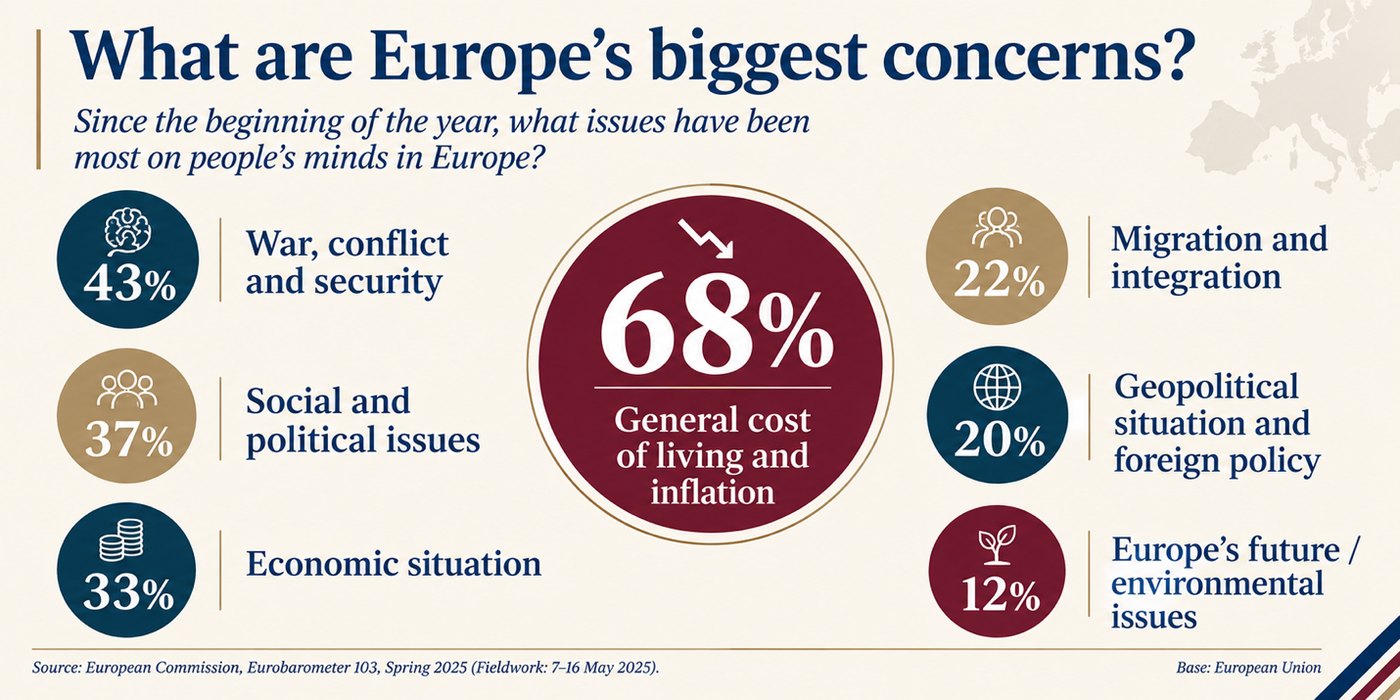
The ECFR survey posed the following question to participants: “If a friend of yours woke up from a long five-year sleep and asked what Europe is like now, what would you tell them?” A majority of respondents, 68% of the total, described Europe as sliding into a general decline, observing that everyday life has unfortunately lost its sense of normality. In addition, 43% said that Europe is contending with war, conflict and insecurity.
These findings suggest that Europeans’ mental image of Europe is turbulent. Unfortunately, only 12% took an optimistic position, holding that “Europe is awakening and responding to international crises.
Those who believe that “Europe is in danger” constitute a high proportion, at 56%. Even so, participants emphasised that the pursuit of a peaceful and secure Union in the future is of fundamental importance. Despite all the turbulence within the Union, 90% of participants called for “More Europe!”. In this regard, the face-to-face interviews suggested that it is Europe’s leaders who will determine what the continent evolves into.
Among those who view the idea of a Europe within a Union favourably overall, 78% are hopeful about the future. However, the field survey highlighted two points in particular. The first is Europe’s slowness (32%), and the second is Europe’s double standards (30%).
Respondents criticised Europe’s bureaucratic apparatus as excessively large and unwieldy, a sentiment captured in the comment that “by the time a decision is taken, the moment has passed.” Participants argued that European countries are willing neither to bear responsibility for major crises nor to delegate their competences. Given that even procedural decisions can take years or decades, Europe seems unlikely to be able to compete with the United States, China and India.1
Another dimension is the perceived absence of honesty and consistency in Europe’s political decisions, especially those relating to integration. This “disappointment” is frequently voiced by France’s LFI, Germany’s Die Linke and the UK’s Green Party. European publics view this double standard as irrational. Russia, for instance, is naturally regarded as the “invader” when it attacks Ukraine. Yet when Israel attacks Palestine, Palestinians are labelled “terrorists”, and Israel’s genocidal policies draw no reaction.
At this point, it must be said that the genocide in Palestine has become a test that shows deep divisions within the European Union. European Commission President Ursula von der Leyen’s almost unconditional support for Israel, despite its human rights violations, has not only damaged her personal reputation. It has also weakened the Union’s basic values, such as human rights, the rule of law and democracy. It has also reduced people’s belief in the idea of a Europe built on values and norms.2
The European Union is the institutional face of the continent, shaped by shared norms. However, since the large enlargement of 2004, when 10 members joined, the plans for the south-east of this geopolitical ideal have been like a chair with a missing leg. After the turmoil and wars in the Balkans in the 1990s, the EU set the long-term goal in 2003 of bringing Serbia, Bosnia and Herzegovina, Kosovo, Montenegro, North Macedonia and Albania into the Union. Yet in 23 years, only Croatia (2013) has been admitted. Although the motivation for EU membership in the Western Balkans still exists, its credibility is growing weaker.3
FALLING LIVING STANDARDS GIVE RISE TO SOCIAL MOVEMENTS IN EUROPE
Even with the turbulence in the world today, Europe is still generally regarded as a place of stability. This view is supported by the fact that human migration worldwide is still moving towards Europe.
According to the results of another survey conducted by the European Parliament, people’s most basic priority in Europe is the “cost of living”. This is followed by economic conditions and finding a job. “Democracy”, which is regarded as a core value of the Union, comes seventh, after security, public health, poverty and climate change.4
Even so, in a world full of problems, 75% of Europeans believe that the EU is a place of stability. In addition, 58% say they are worried about the future. The main reason behind this is a sense of uncertainty for the future (44%).
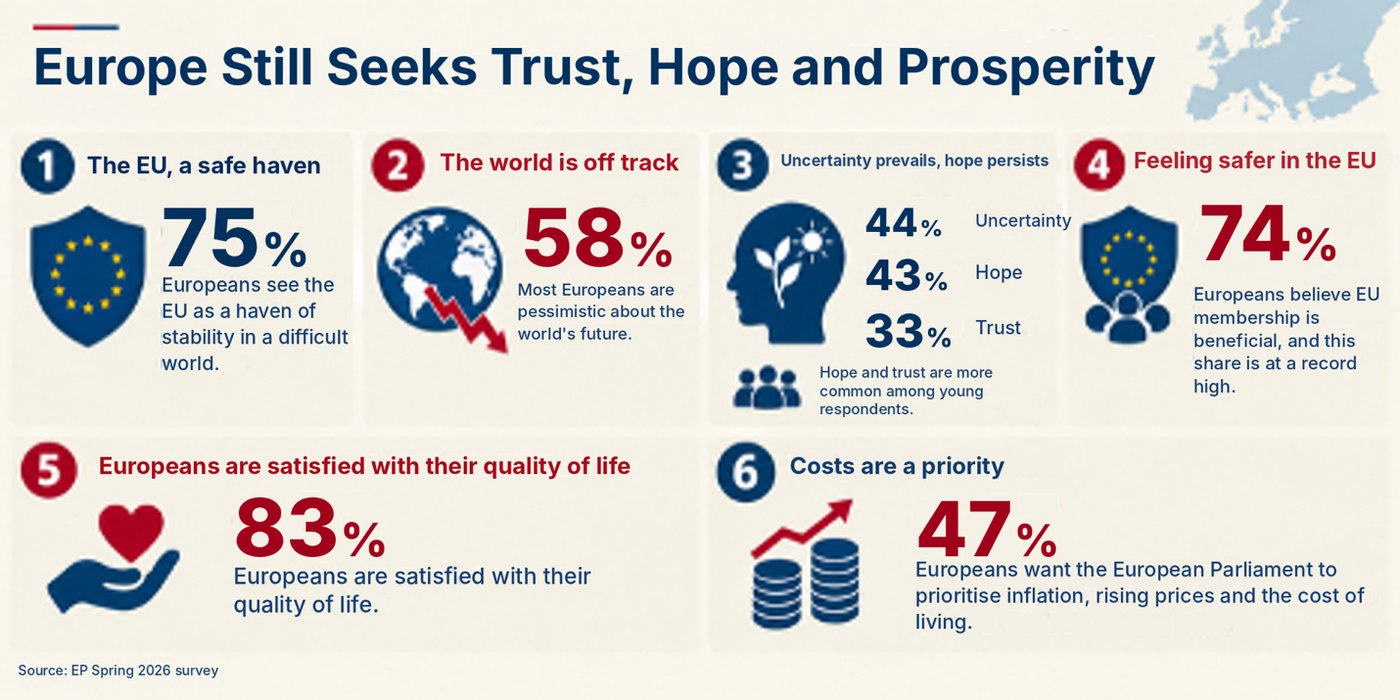
However, it must also be stressed that this whole picture does not point to fragmentation or collapse of the EU among its citizens. An overwhelming majority of Europeans (90%) call for unity and cooperation under current conditions, and 75% see the EU as a safe haven. They also stress that the EU should encourage respect for international law in the global order. It appears that the peoples of the Union want the idea of Europe as an institution of norms and ideals to continue to be nurtured. Indeed, this emphasis is supported by the European Parliament survey, in which 74% underlines “membership is beneficial”.5
STREET PROTESTS CONFIRM THE SURVEY RESULTS
In October 2026, protests began at the same time in many European countries over the cost of living, the housing crisis and the decline of public services. This reflects, in a way, the results of the surveys carried out by the European Parliament and the ECFR. In France, protests that began in autumn 2026 with the education demands of high school students turned into demands about “cost of living” and became more and more violent.6 In Italy, 271 people were detained during demonstrations on 18 October against military spending and luxury, and the protests spread to cities such as Rome and Bologna.7 In Portugal, Spain and Belgium, protests against high housing costs and rents continue to spread.8 In Albania, student movements against corruption in Edi Rama’s government are also growing.9
People in Europe are poorer now than they were before the coronavirus crisis in 2020. They do not want to lose what they still have. The surveys show how much stress rising prices put on society. The protests that started in autumn 2026 came from two things: people can buy less with their money, and young people do not feel hopeful about the future.
ENDNOTES
1. Pawel Zerka, “Future Nostalgia: Europe’s Unfinished Song”, ECFR, Eylül 2026. https://ecfr.eu/special/future-nostalgia-europes-unfinished-song/
2. Selim Vatandaş, “İki Yüzlü mü Yoksa İkircikli mi?: Avrupa Birliği’nin Gazze Krizi’ndeki Hezimeti” [Hypocritical or ambivalent?: The European Union’s debacle in the Gaza crisis], İNSAMER Analiz, 5 December 2023. https://www.insamer.com/tr/uploads/pdf/iki-yuzlu-mu-yoksa-ikircikli-mi.pdf
3. EU Reporter, “Support for EU accession remains high across enlargement partners, latest surveys show”, June 2026, https://www.eureporter.co/politics/eu-accession/2026/06/23/support-for-eu-accession-remains-high-across-enlargement-partners-latest-surveys-show/; Among the Western Balkan countries, Albania (92%) and Kosovo (83%) show the strongest motivation for EU membership. In Montenegro, North Macedonia and Bosnia and Herzegovina, more than 60% of people view EU accession positively. Serbia has the lowest level of support for membership, at 31%.
4. European Commission, Standard Eurobarometer 105 - Spring 2026 https://europa.eu/eurobarometer/surveys/detail/3613
5. European Parliament, “EP Spring 2026 Survey”, https://europa.eu/eurobarometer/surveys/detail/3752
6. Janis Laizans, Stamos Prousalis ve Yann Tessier, “Mass protests in France spiral into worst riots in years”, Reuters, 17 October 2026 https://www.reuters.com/world/students-trade-unions-yellow-vests-set-protest-across-france-2026-10-17/
7. Elisa Anzolin, “Milan luxury shops close for fear of new unrest as government prepares to deploy troops”, Reuters, 19 October 2026 https://www.reuters.com/world/italian-police-detain-hundreds-stores-looted-weekend-unrest-milan-2026-10-19/
8. Le Monde “Italy, Spain, Belgium, Portugal: Social unrest spreads across Europe amid soaring energy prices and a housing crisis” 20 October 2026, https://www.lemonde.fr/en/international/article/2026/10/20/italy-spain-belgium-portugal-social-unrest-spreads-across-europe-amid-soaring-energy-prices-and-a-housing-crisis_6759435_4.html
9. Elona Elezi, “Albania’s student protests are only getting bigger” Deutsche Welle, 23 October 2026, https://www.dw.com/en/albanias-student-protests-are-only-getting-bigger/a-79735213


