

INTRODUCTION
General elections held in Bosnia and Herzegovina on 4 October 2026 brought renewed attention not only to political figures and parties but also to the functioning of the country’s post-war order. Voters cast their ballots for the three-member Presidency, state and entity parliaments, the entity presidency, and cantonal assemblies. Yet winning an election in Bosnia and Herzegovina does not necessarily mean gaining power.
In a system where the distinction between holding office and exercising effective authority is particularly pronounced, differing electoral rules, guarantees of ethnic representation, and numerous decision-making bodies make it difficult to translate the will expressed at the ballot box into workable government policies. International observers likewise noted that the elections were competitive, while political fragmentation and shortcomings in electoral administration persisted.1
Announced results indicate that two members of the Presidency retained their positions, while the Croat seat changed hands. Meanwhile, the principal parties largely maintained their positions in the parliamentary contests, demonstrating that the elections expressed both political continuity and a demand for change.2 It is therefore important to assess the results beyond the electoral achievements of individual parties, considering their implications for Bosnia and Herzegovina’s administrative and institutional functioning, its domestic political, economic and social stability, power relations in the Balkans, and the European Union (EU) accession process.
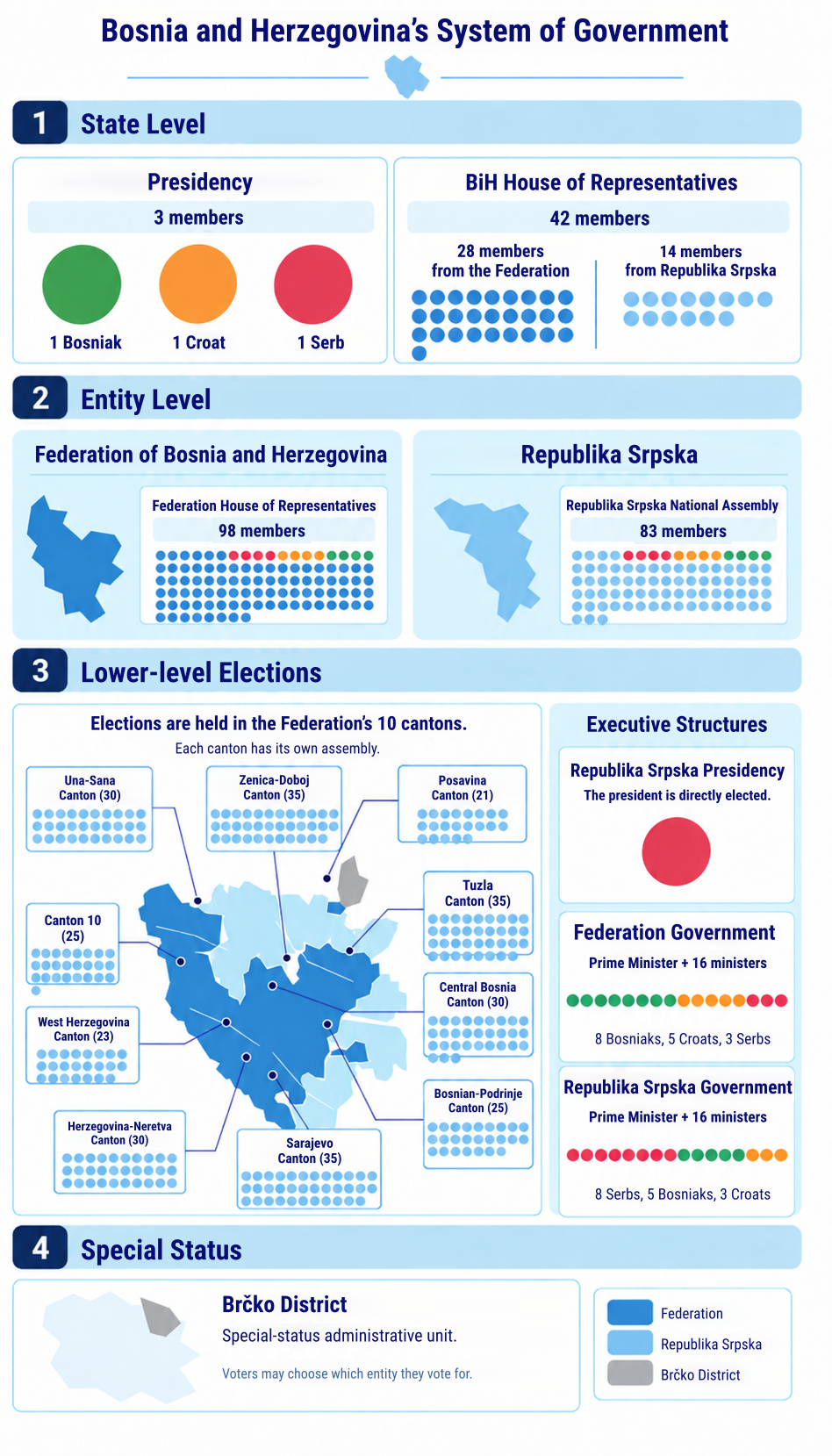
Bosnia and Herzegovina’s system of government, from the state Presidency down to the cantonal assemblies and the Brčko District.
ELECTORAL SYSTEM, POLITICAL BLOCS AND RESULTS
Bosnia and Herzegovina’s political and administrative system was shaped by the Dayton Peace Agreement, which ended the 1992-1995 war. The state comprises two entities: the Federation of Bosnia and Herzegovina and Republika Srpska (RS). The Federation also contains ten cantons, each with its own assembly and government, while Brčko is a district with special status under the sovereignty of the state. The Presidency consists of one Bosniak and one Croat member elected from the Federation and one Serb member elected from RS. Its members serve four-year terms, with the chair rotating among them every eight months. Of the 42 seats in the directly elected House of Representatives of Bosnia and Herzegovina, 28 are allocated to the Federation and 14 to RS. The 15-member House of Peoples, the other chamber of the bicameral state parliament, is constituted indirectly. At entity level, the Federation House of Representatives has 98 members and the RS National Assembly has 83. The RS president and vice-presidents are also directly elected.3
In general elections, each voter makes four separate choices. Voters in the Federation cast ballots for the Presidency, the state and Federation houses of representatives, and their cantonal assembly. In RS, the election of the entity president and vice-presidents replaces the cantonal ballot. The ballots available to voters in Brčko are determined by their entity citizenship. Municipal elections follow a separate timetable.4
While guaranteeing representation for the three constituent peoples, the Dayton order establishes mechanisms of mutual consent in the legislature and executive. Consequently, the formation of post-election governments is not determined solely by the distribution of parliamentary votes. The international component of the system is the Office of the High Representative (OHR), which oversees the civilian implementation of the peace agreement.5 The binding intervention powers developed through the 1997 Bonn Conclusions can help overcome serious deadlocks, but also raise questions about the responsibility of elected institutions and democratic accountability.6
In the electoral contest, the Party of Democratic Action (SDA), the Social Democratic Party (SDP BiH), the Party for Bosnia and Herzegovina (SBiH), and the Union for a Better Future (SBB) were prominent within the Bosniak political sphere. Cooperation between SDP BiH, People and Justice (NiP), and Our Party (NS), known as the Trojka, continued, while 14 parties supported Denis Bećirović’s candidacy under the umbrella of United for the State of Bosnia and Herzegovina.7 In the Croat political sphere, the Croatian Democratic Union (HDZ BiH) competed with the Democratic Front (DF) and the parties supporting independent candidate Zdenko Lučić. In RS, the Alliance of Independent Social Democrats (SNSD), the Serb Democratic Party (SDS), and the bloc led by the Movement for a Safe Srpska (PSS) were the decisive actors.
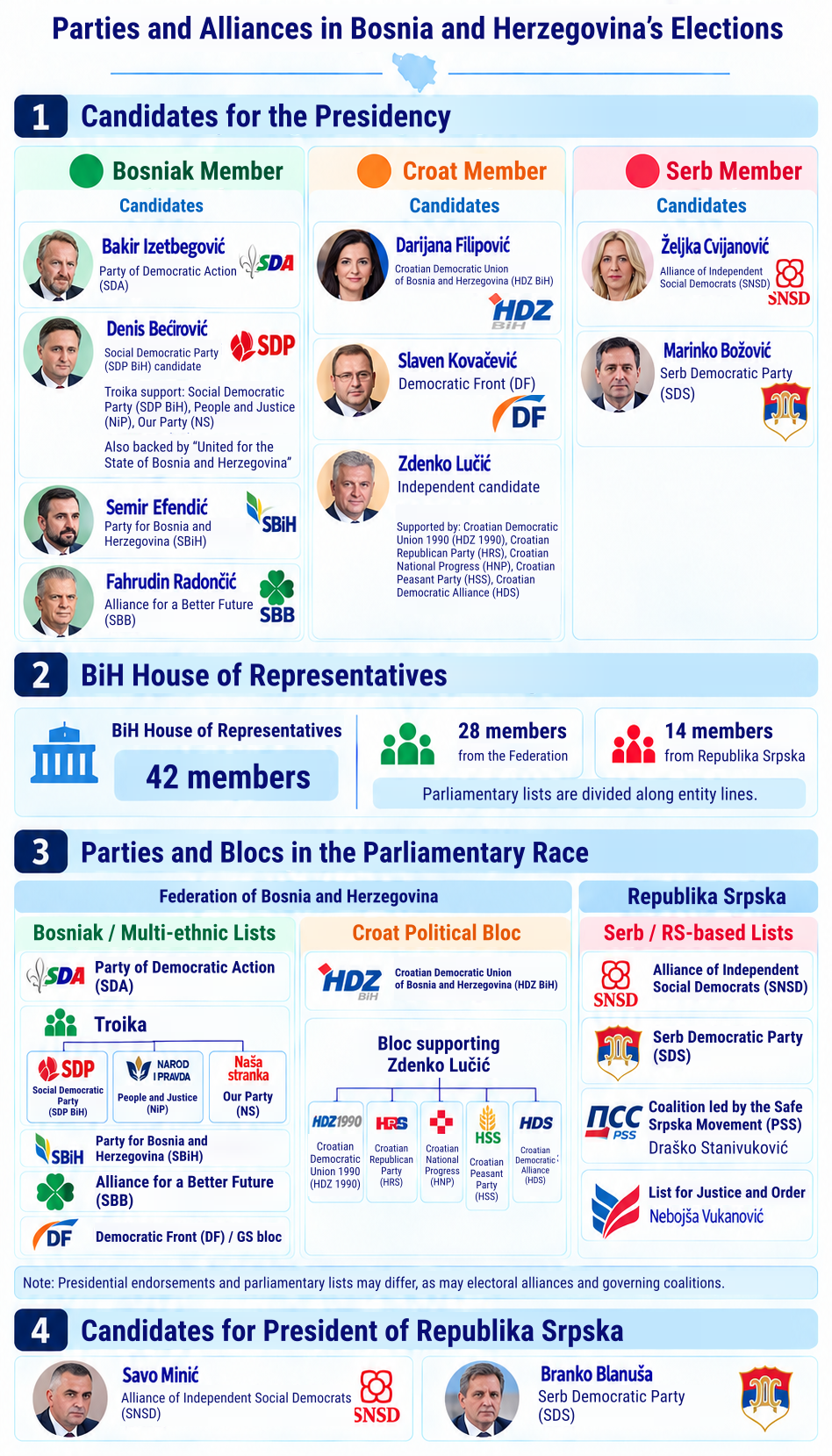
Candidates and party blocs contesting the general elections of 4 October 2026.
According to figures released by the Central Election Commission (CIK), voter turnout stood at 42.79%. This represents a decline of 8.66 percentage points from the 51.45% turnout recorded in the 2022 elections. Biometric verification and ballot scanners, used nationwide for the first time in these elections, were intended to limit electoral irregularities. However, the use of numbers instead of candidates’ names, inadequate information, and technical problems made voting more difficult, particularly for voters in certain age groups.8 The extent to which the decline in turnout stemmed from political disengagement, implementation problems, or the prevention of past irregularities remains a separate matter of debate.
According to the results announced by CIK, Bećirović finished first in the contest for the Bosniak seat in the Presidency with 215,944 votes (38.11%), Darijana Filipović won the Croat seat with 111,671 votes (46.51%), and Željka Cvijanović won the Serb seat with 305,911 votes (55.58%). They were thus elected as the members representing their respective ethnic groups.9 In the RS presidential contest, SNSD candidate Savo Minić received 289,287 votes (52.33%), while SDS candidate Branko Blanuša received 230,863 votes (41.76%).10
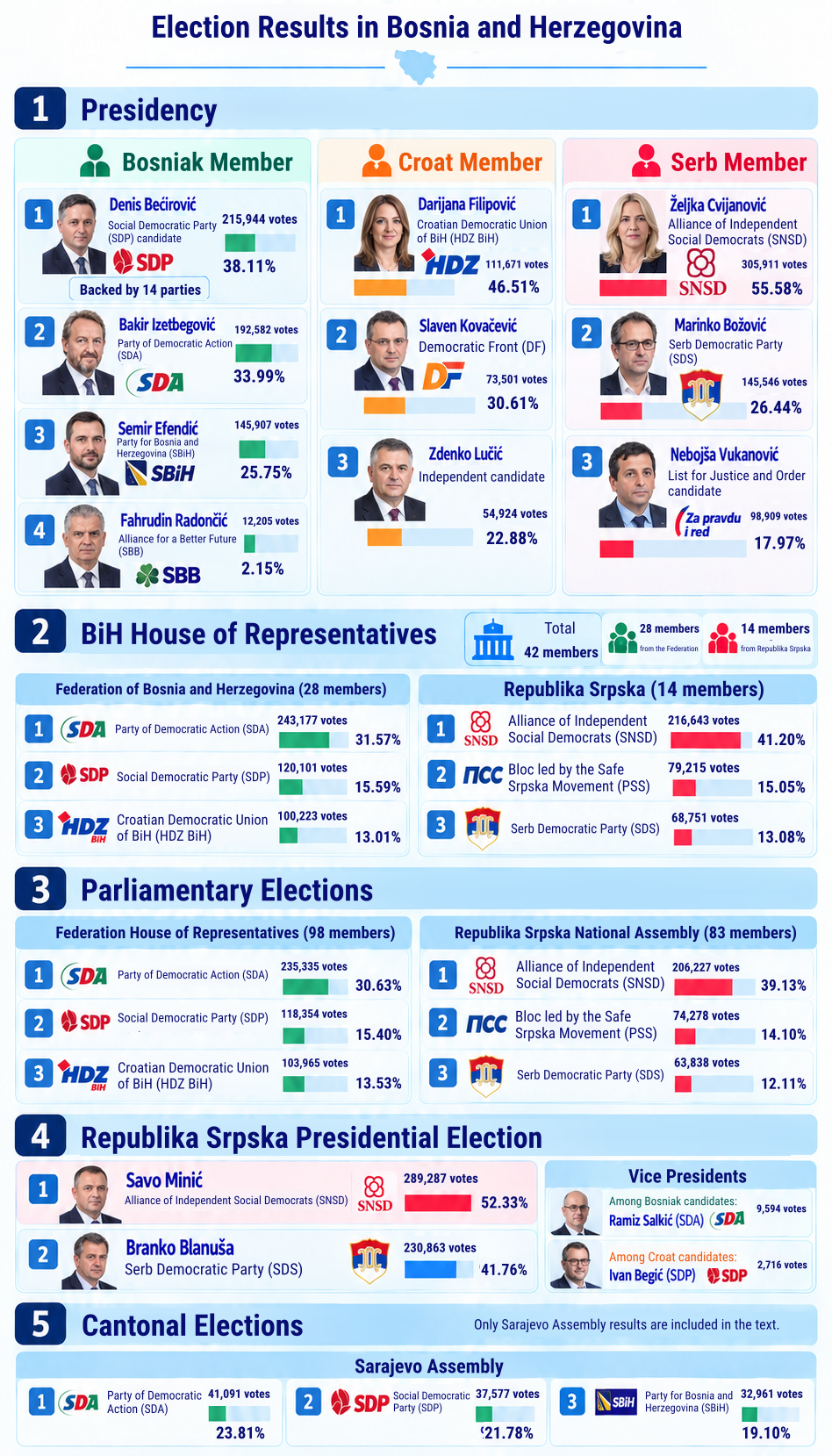
Results of the 4 October 2026 elections: the Presidency, the state and entity parliaments, the Republika Srpska presidency and the Sarajevo Cantonal Assembly.
In the elections to the House of Representatives of Bosnia and Herzegovina, SDA received 31.57%, SDP BiH 15.59%, and HDZ BiH 13.01% in the Federation contest. In RS, SNSD secured 41.20%, the PSS-led bloc 15.05%, and SDS 13.08%.11 In the entity assemblies, SDA also finished first in the Federation with 30.63%, as did SNSD in RS with 39.13%.1213 In the Sarajevo Cantonal Assembly, one of the Federation’s ten cantonal assemblies and particularly significant because it serves the capital canton, SDA received 23.81%, SDP BiH 21.78%, and SBiH 19.10%.14 These shares do not, by themselves, constitute a sufficient majority to form a government. While presidential election results directly determine the winners and officeholders, translating electoral strength in the assemblies into a governing majority will depend on coalition agreements.
THE POLITICAL AND REGIONAL SIGNIFICANCE OF THE ELECTIONS
The first striking outcome of the elections is the divergence between low turnout and the institutional weight of established parties in Bosnia and Herzegovina’s political system. Despite declining participation, parties capable of mobilising their organised electoral bases were able to maintain their political influence even with fewer votes. The results nevertheless show that parties’ declarations of victory cannot be equated with expanding public support. Although a certain degree of confidence in the ballot has been secured through technical measures, sufficient public trust in politics has yet to be established.
Another important feature of the elections is that voters do not support a party and a candidate for the same reasons. This crisis of confidence in Bosnia and Herzegovina’s politics extends to the representative standing of party leaders. Although SDA finished first in parliamentary elections at both state and Federation levels, Bakir Izetbegović’s second defeat in the race for the Presidency highlighted the divergence between loyalty to the party and acceptance of its leader. While the results strengthened SDA’s claim to return to power, they also reopened the debate over leadership renewal. Denis Bećirović’s success in the presidential contest, meanwhile, indicates that voters were not satisfied with the parliamentary performance of the political parties supporting him.
Semir Efendić’s receipt of approximately one quarter of the valid votes in the contest for the Bosniak seat in the Presidency was one of the elections’ most notable results. The support gathered around the SBiH candidate can be read as a search for a third way, in opposition to both the political bloc backing Bećirović and the SDA leadership. It would be mistaken to treat all of Efendić’s votes as defections from SDA simply because he had left that party. Such an assumption would reduce voter preferences to the electoral bases of the two principal rivals. Efendić’s success demonstrates his ability to attract support beyond the existing polarisation. His next test will be whether he can translate that support into an independent programme in coalition negotiations.
On the Serb side, Milorad Dodik’s ban from public office has not ended his dominance over his party. Željka Cvijanović’s retention of her seat in the Presidency demonstrates that, although Dodik has lost office, he has not lost political influence, and that the political outlook he represents remains one of the significant forces shaping Bosnia and Herzegovina’s politics. His statement immediately before the elections “Bosnia and Herzegovina is dead. This is an impossible country”15 is significant in this context. Beyond being a populist declaration, this rhetoric seeks to turn the claim that Bosnia and Herzegovina’s political system and institutions do not function into a justification for secession.
The rise of the PSS list led by Draško Stanivuković in RS has primarily altered the leadership balance within the opposition. PSS’s overtaking of SDS does not, in itself, suggest that the opposition bloc has established a viable alternative to the government. Indeed, the failure to translate competition within the opposition into a shared programme and lasting cooperation is one of the most important factors enabling SNSD’s continued dominance.
The most significant change in the Presidency has been the election of HDZ candidate Darijana Filipović. While Bećirović and Cvijanović will be serving their second terms, this will be Filipović’s first. The fact that Cvijanović and Filipović are candidates of parties politically representing the Serb and Croat separatist camps also means that the rapprochement between HDZ and SNSD could find expression within the Presidency.
Although this is not the first time Croat and Serb nationalist parties have served together in the Presidency, the possibility of their cooperation marks a particularly critical juncture in the current political context. International reports from the period indicate that, in the country’s first post-war Presidency, elected in 1996, Croat member and HDZ candidate Krešimir Zubak and Serb member Momčilo Krajišnik, the candidate of the Serb Democratic Party (SDS / Srpska demokratska stranka), at times sought to cooperate against the Bosniak bloc within collective governing mechanisms, acting on shared interests in opposition to Bosniak representative and SDA leader Alija Izetbegović.16 Nevertheless, the present partnership cannot be regarded as ideologically cohesive. HDZ’s European orientation and SNSD’s proximity to Russia entail significant differences in foreign policy.17
The principal factor that could bring the two parties closer is their ability to reinforce their claims to ethnic representation through mutual support in bargaining at state level. Foreign policy and diplomatic appointments, in particular, could become subjects of continuous negotiation through reciprocal obstruction. Such a process risks narrowing the state’s practical room for action while leaving its legal existence intact.
Dayton’s structural problem becomes apparent here: arrangements for mutual consent and vetoes, designed to prevent conflict, can become instruments of political bargaining that delay decision-making. The resolution of the deadlock over the formation of the Federation government through an OHR decision in 2023 provides a concrete example of this tension.18 International intervention can ensure institutional functioning in the short term, but its repetition risks strengthening elected politicians’ tendency to transfer their responsibility to reach compromise to external actors. Protecting the rights of the constituent peoples and expanding individual political equality should therefore not be treated as alternative objectives.
At the regional level, the positions of Belgrade and Zagreb will remain decisive. Whether they encourage their partners in Bosnia and Herzegovina to compromise or to advance more extensive demands will also matter for political balances in the Balkans in the period ahead. Conducting Serbia’s relations with RS within a framework that respects Bosnia and Herzegovina’s sovereignty could limit the ability of entity leaders such as Dodik to use external support to strengthen their bargaining position vis-à-vis central institutions. The close and organic relationship between the Croatian government and HDZ BiH likewise provides strong grounds for expecting Croatia to influence the demands and policies of the Croat bloc in Bosnia and Herzegovina. Presenting the closeness between HDZ and SNSD as the shared will of the Serb and Croat communities could turn competition between political parties into ethnic confrontation. If the EU treats the formation of a government in Bosnia and Herzegovina as progress in itself, it could strengthen actors who continually expect concessions in return for ending obstruction.
IMPLICATIONS OF THE ELECTIONS FOR TÜRKİYE
The election results demonstrate the limits of basing Türkiye’s relations with Bosnia and Herzegovina on a single political actor or a particular strand of representation within the Bosniak community. Ankara’s historical and cultural affinity is an important diplomatic asset. However, SDA’s parliamentary weight, Bećirović’s position in the Presidency, and the representative strength of other political actors must each be taken into account. The approach of the Ministry of Foreign Affairs of the Republic of Türkiye, which emphasises dialogue with all three constituent peoples and support for Bosnia and Herzegovina’s sovereignty, offers an inclusive basis in this respect.19
The trilateral consultation mechanisms maintained with Serbia and Croatia should be used not merely for contact between leaders, but also to support the decision-making capacity of state institutions in the interests of Bosnia and Herzegovina’s political, economic and social stability. Such an approach also requires consistency in Türkiye’s relations with regional actors. Ensuring that contacts with Belgrade and Zagreb do not turn into claims to make decisions on behalf of Bosnia and Herzegovina reinforces the standing of its common state institutions as interlocutors. Trilateral diplomacy gains value to the extent that it keeps channels of negotiation open within Bosnia and Herzegovina and supports mutual guarantees, while avoiding the appearance of a new mechanism of external tutelage.
In economic and security cooperation, the priority will be to translate political declarations into tangible outcomes. Bilateral trade declined from USD 1.076 billion in 2024 to USD 1.052 billion in 2025.20 This is significant because it demonstrates that close diplomatic relations do not automatically produce economic growth. Türkiye’s contribution should be measured by Bosnia and Herzegovina’s institutional integrity and the benefits accruing to its citizens, rather than by the influence of any particular party.
CONCLUSION
The 4 October elections demonstrate that political continuity in Bosnia and Herzegovina has not eliminated differences in voter preferences. While established and well-organised political parties such as SDA and SNSD have maintained their parliamentary weight, the presidential contests show that the same voter can distinguish between party and candidate preferences. Yet, within a multilayered system of government, finishing first in an election does not, by itself, confer the ability to form a government or implement reforms. The real test of the new period will be whether the election results can be translated into a shared capacity to govern across institutions operating at different levels.
Political equality, democratic responsibility and effective decision-making must be strengthened while preserving the Dayton order’s role in safeguarding peace. For the EU, genuine progress should be sought in reforms that can be implemented rather than in the number of coalitions formed; for neighbouring countries and Türkiye, it should be sought in their contribution to Bosnia and Herzegovina’s sovereign institutions rather than in relationships of influence. In this respect, the ultimate significance of the elections lies less in which party received more votes than in the extent to which the resulting political balance improves the functioning of the common state.
REFERENCES
1. OSCE/ODIHR. “Genuine Competition in Bosnia and Herzegovina’s Elections in Fragmented Political Environment and with Difficulties in Electoral Administration.” 5 October 2026. https://odihr.osce.org/odihr/668244
2. Reuters, Branko Filipovic & Fedja Grulovic. “Leftist, nationalists set to win election for Bosnia’s tripartite presidency.” 5 October 2026. https://www.reuters.com/world/bosnia-votes-sunday-election-that-could-affect-eu-bid-2026-10-04/
3. Constitution of Bosnia and Herzegovina. Dayton Peace Agreement, Annex 4, Articles I, IV and V. 1995. https://www.ohr.int/dejtonski-mirovni-sporazum/annex-4/
4. OSCE Office for Democratic Institutions and Human Rights (ODIHR). Bosnia and Herzegovina General Elections 4 October 2026: Interim Report, 20 August–16 September 2026. 18 September 2026. pp. 3–11.
5. Peace Implementation Council (PIC). “Bonn Conclusions,” Section XI. 10 December 1997. https://www.ohr.int/pic-bonn-conclusions-2/
6. Council of Europe Venice Commission. Opinion on the Constitutional Situation in Bosnia and Herzegovina and the Powers of the High Representative. CDL-AD(2005)004, 11–12 March 2005. https://www.venice.coe.int/webforms/documents/CDL-AD%282005%29004-e.aspx
7. Euronews.ba. “Četrnaest stranaka uz Bećirovića kao kandidata za Predsjedništvo BiH” [Fourteen Parties Support Bećirović as a Candidate for the Presidency of Bosnia and Herzegovina]. 4 April 2026. https://www.euronews.ba/bosna-i-hercegovina/politika/54917/cetrnaest-stranaka-uz-becirovica-kao-kandidata-za-predsjednistvo-bih-usvojena-i-zajednicka-deklaracija
8. International Election Observation Mission. Bosnia and Herzegovina General Elections 4 October 2026: Statement of Preliminary Findings and Conclusions. OSCE/ODIHR, 5 October 2026.
9. Klix.ba. “Rezultati Općih izbora 2026” [Results of the 2026 General Elections]. 10 October 2026. https://izbori.klix.ba/opci-izbori-2026
10. Klix.ba. “Predsjednik i potpredsjednici Republike Srpske—rezultati izbora 2026” [President and Vice-Presidents of Republika Srpska—2026 Election Results]. 10 October 2026. https://izbori.klix.ba/opci-izbori-2026/predsjednik-i-potpredsjednici-republike-srpske
11. Klix.ba. “Predstavnički dom PSBiH—rezultati izbora 2026” [House of Representatives of the Parliamentary Assembly of Bosnia and Herzegovina—2026 Election Results]. 10 October 2026. https://izbori.klix.ba/opci-izbori-2026/parlament-bih
12. Ibid.
13. Klix.ba. “Narodna skupština Republike Srpske—rezultati izbora 2026” [National Assembly of Republika Srpska—2026 Election Results]. 10 October 2026. https://izbori.klix.ba/opci-izbori-2026/narodna-skupstina-rs
14. Klix.ba. “Skupština Kantona Sarajevo—rezultati izbora 2026” [Sarajevo Cantonal Assembly—2026 Election Results]. 10 October 2026. https://izbori.klix.ba/opci-izbori-2026/skupstina-kantona-sarajevo
15. Al Jazeera. “Dodik declared Bosnia ‘dead’. Irrelevant rhetoric or serious threat?” 4 October 2026. https://www.aljazeera.com/news/2026/10/4/dodik-declared-bosnia-dead-irrelevant-rhetoric-or-serious-threat
16. The Washington Post, John Pomfret. “Alliance of Serbs, Croats Seen Forming in Bosnia.” 20 September 1996. https://www.washingtonpost.com/archive/politics/1996/09/20/alliance-of-serbs-croats-seen-forming-in-bosnia/99777a73-0cbb-476e-8ac5-a5abb71bc4c6/
17. Reuters, Branko Filipovic & Fedja Grulovic. “Leftist, nationalists set to win election for Bosnia’s tripartite presidency.” 5 October 2026. https://www.reuters.com/world/bosnia-votes-sunday-election-that-could-affect-eu-bid-2026-10-04/
18. Office of the High Representative (OHR). “Decision on Unblocking the Appointment of the Government of the Federation of Bosnia and Herzegovina.” 27 April 2023. https://www.ohr.int/decision-unblocking-the-appointment-of-the-government-of-the-federation-of-bosnia-and-herzegovina/
19. Ministry of Foreign Affairs of the Republic of Türkiye. “Türkiye–Bosnia and Herzegovina Relations.” Political relations and 2024–2025 trade figures based on Turkish Statistical Institute (TurkStat) data. 2026. https://www.mfa.gov.tr/turkiye-bosna-hersek-siyasi-iliskileri-.tr.mfa
20. Ibid.


